
Terralonus californicus
(G. W. Peckham & E. G. Peckham, 1888)
Intertidal Jumping Spider, Beach Jumping Spider
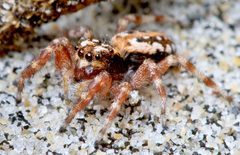
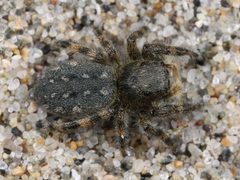
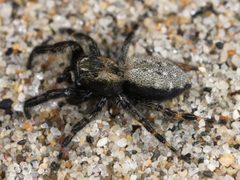
Terralonus californicus is a jumping spider in the Salticidae, notable as one of the few spider known to regularly inhabit coastal beach environments. It is found in the United States, primarily along the Pacific coast. The species has been documented through over 750 observations on iNaturalist, indicating it is relatively well-observed among coastal arachnids. Its intertidal distinguishes it from most other jumping spiders, which typically occupy terrestrial vegetation and ground habitats.
Pronunciation
How to pronounce Terralonus californicus: /tɛrəˈloʊnəs kælɪˈfɔrnɪkəs/
These audio files are automatically generated. While they are not always 100% accurate, they are a good starting point.
Identification
Distinguished from other jumping spiders by its consistent occurrence in sandy beach and intertidal . Separation from congeneric requires examination of genitalic and other detailed taxonomic characters not readily apparent in field observation. The combination of coastal beach habitat with jumping spider morphology is diagnostic for field recognition.
Images
Appearance
As a member of Salticidae, possesses the characteristic enlarged that provide acute vision typical of jumping spiders. Specific morphological details for this are not well documented in available sources. The Terralonus contains species generally adapted to ground-dwelling habits.
Habitat
Sandy beaches and intertidal zones along coastlines. One of the few spider documented to regularly inhabit beach environments, tolerating conditions of shifting sand, salt spray, and periodic tidal inundation.
Distribution
United States, specifically along the Pacific coast. GBIF records confirm presence in North America with distribution centered in the USA. Precise range boundaries within the United States are not fully documented in available sources.
Behavior
Active hunter using vision-based typical of salticid spiders. Has been observed to occupy beach environments where it likely exploits prey associated with coastal wrack and intertidal debris.
Ecological Role
in coastal beach . Contributes to in an environment with relatively few spider inhabitants.
Human Relevance
Subject of citizen science documentation through iNaturalist, with over 750 observations contributing to understanding of its distribution and use. Serves as an example of to challenging coastal environments.
Similar Taxa
- Other Terralonus speciesRequire genitalic examination for definitive separation; preference may provide initial differentiation
- Other SalticidaeDistinguished by consistent beach association; most jumping spiders occupy vegetation or ground habitats away from coastlines
More Details
Taxonomic history
Described by G. W. Peckham and E. G. Peckham in 1888, prominent early American arachnologists who contributed extensively to jumping spider .
Habitat specialization
Among the most -specialized jumping spiders in North America, representing a rare case of salticid to intertidal conditions.
Sources and further reading
- BugGuide
- Wikipedia
- GBIF taxonomy match
- iNaturalist taxon
- Catalogue of Life
- Encyrtid Holdings | Entomology Research Museum
- California Has No State Bee--Yet! | Bug Squad
- Bohart Museum: Learn about California's State Insect on UC Davis Picnic Day | Bug Squad
- Grasshoppers of Colorado
- Grasshoppers of Colorado
- Sex Attraction Pheromone Improves Detection of a Threatened Beetle