
Phidippus putnami
(G. W. Peckham & E. G. Peckham, 1883)
Putnam's Jumping Spider
Phidippus putnami is a of jumping spider in the Salticidae, native to the United States. Like other members of its , it possesses the characteristic large that provide acute vision for hunting and navigation. The species has gained attention in popular culture through the informal nickname "spooder," reflecting broader trends in anthropomorphizing spiders to foster public appreciation. Observations indicate it occupies wooded and preys on small insects.
Pronunciation
How to pronounce Phidippus putnami: //ˈfɪdɪpəs ˈpʌtnəˌmaɪ//
These audio files are automatically generated. While they are not always 100% accurate, they are a good starting point.
Identification
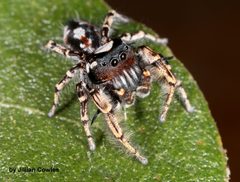
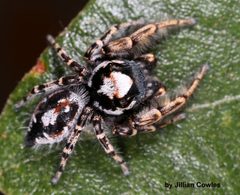
Distinguished from other Phidippus by its relatively subdued coloration and association with the putnami species-group. The blue-green in males, while present in several Phidippus species, may be less vivid than in P. audax. Accurate identification to species level typically requires examination of genitalia. Subadult individuals may show transitional coloration and patterns.
Images
Appearance
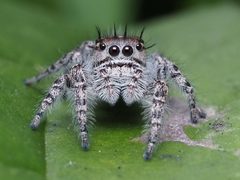
A medium-sized jumping spider with relatively subdued coloration compared to . The body is compact and stocky, typical of the Phidippus. Males possess iridescent blue-green (fangs) that are visible when the spider is actively feeding or displaying. The arrangement features two very large, forward-facing eyes that dominate the front of the , surrounded by six smaller eyes. Coloration is generally drab, lacking the bold patterns seen in like Phidippus audax.
Habitat
Occupies wet-mesic bottomland forests and wooded areas. Has been observed on lower branches of deciduous trees including sweetgum (Liquidambar styraciflua). Requires vegetation that supports small insect prey and provides perches for ambush hunting.
Distribution
United States; recorded from Missouri and other states within its range. Distribution records indicate presence across North America in suitable wooded .
Diet
Active of small insects. Documented feeding on blow flies ( Calliphoridae).
Behavior
Displays typical salticid hunting : stalking prey visually, approaching cautiously, and pouncing with a silk safety line attached. When disturbed, turns to the intruder rather than fleeing immediately, characteristic of the . Maintains grip on captured prey and resists dropping it even when approached. Uses silk draglines when jumping to prevent falling.
Ecological Role
controlling of small flying and crawling insects in forest understory .
Human Relevance
Subject of macrophotography due to approachable and charismatic appearance. Popularized through internet culture under the nickname "spooder," which has been used in science communication to reduce arachnophobia and foster appreciation for jumping spiders. Frequently photographed at close range due to of human approach.
Similar Taxa
- Phidippus audaxSimilar size and body plan; distinguished by generally bolder coloration with distinct white or light spots on , and more vivid in males
- Other Phidippus speciesMany share stocky build and large ; accurate separation requires examination of in females or in males
More Details
Science Communication Relevance
P. putnami has become emblematic of debates around in science communication. The nickname "spooder" exemplifies how informal language can bridge gaps between scientists and the public, though practitioners debate appropriate contexts for such usage.
Photographic Documentation
The has been documented in behavioral observations where individuals were photographed feeding on prey without abandoning it, demonstrating the tenacity typical of salticid hunting .