
Hakka himeshimensis
(Dönitz & Strand, 1906)
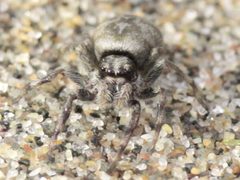
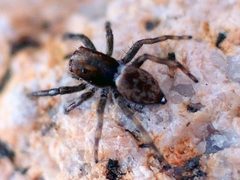
Hakka himeshimensis is a small jumping spider (Salticidae) native to East Asia and introduced to the eastern United States, likely via maritime shipping. It is the sole in the Hakka. Both sexes measure approximately 7 mm in body length with uniformly dark brown coloration. The species shows a strong preference for rocky coastal .
Pronunciation
How to pronounce Hakka himeshimensis: /ˈhak.a hi.mɛ.ʃiˈmɛn.sɪs/
These audio files are automatically generated. While they are not always 100% accurate, they are a good starting point.
Identification
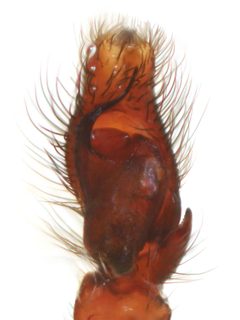
Distinguished from other small jumping spiders by its uniformly dark brown body and legs combined with the distinctive reddish, diagonally projecting hairs between the . The robust brown are additional identifying features. The small size (7 mm) and coastal preference help narrow identification.
Images
Habitat
Rocky coastal . The shows strong association with maritime environments in both its native and introduced ranges.
Distribution
Native to China, North Korea, and Japan. Introduced to the eastern United States (likely via maritime shipping) and Hawaii, though Hawaiian status remains uncertain—specimens have been collected over 74 years but may represent incidental arrivals rather than a viable population.
Human Relevance
The name references the Hakka people of China, who were brought to Hawaii as laborers on sugar cane plantations in the mid-19th century, reflecting the ' Asian origin. The species has been introduced to North America through human maritime activity.
Similar Taxa
- Other small SalticidaeH. himeshimensis can be distinguished by the combination of uniformly dark brown coloration, diagonally projecting reddish interocular hairs, and robust , whereas many similar-sized jumping spiders show more variable color patterns or lack these specific hair arrangements.
More Details
Etymology
The name Hakka derives from the Hakka Chinese people, with approximately 70 million members worldwide. This naming choice by Berry & Prószyński (2001) references the historical connection between East Asia and Hawaii through Hakka laborers on sugar plantations.
Taxonomic history
Originally described by Dönitz & Strand in 1906, the was later placed in the new Hakka by Berry & Prószyński in 2001 based on specimens from Hawaii and East Asia.