
Habronattus amicus
(G. W. Peckham & E. G. Peckham, 1909)
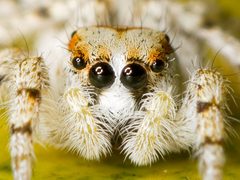
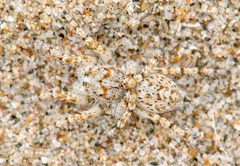
Habronattus amicus is a small jumping spider ( Salticidae) found in the western United States and parts of western Canada. It belongs to the -rich Habronattus, which is particularly diverse in southwestern North America. The species has been the subject of phylogeographic research revealing complex evolutionary dynamics, including localized mitochondrial with syntopic species such as H. ustulatus in dune systems of south-central Oregon. Like other members of its genus, it is a ground-dwelling, visually-oriented .
Pronunciation
How to pronounce Habronattus amicus: /hæbrəˈnætəs əˈmaɪkəs/
These audio files are automatically generated. While they are not always 100% accurate, they are a good starting point.
Identification
Morphologically distinguished from syntopic H. ustulatus through multivariate analyses, though small H. amicus females overlap in size with large H. ustulatus males. As with other Habronattus , males likely possess species-specific visual signals involving leg ornamentation and coloration used in , though specific characters for H. amicus are not detailed in available sources.
Images
Habitat
Dune systems in south-central Oregon have been documented as , where it occupies different microhabitats than H. ustulatus at most sites; microhabitat distinction breaks down at Summer Lake, Oregon. As a ground-dwelling Habronattus , it likely occurs in areas of scattered vegetation, stones, and leaf litter typical of the .
Distribution
Western North America: western United States and parts of western Canada including Alberta and Manitoba. Specifically documented from dune systems in south-central Oregon.
Behavior
Males of the Habronattus perform elaborate multimodal combining visual signals (leg movements, coloration displays) with vibratory drumming on the substrate. H. amicus specifically has been observed in syntopy with H. ustulatus, with which it may interact ecologically and genetically.
Ecological Role
in ground-dwelling of arid western . Documented presence influences anti-predator adaptations in other insects, including predator mimicry by bee flies in the Epacmus ( Bombyliidae), which display -like markings resembling those of Habronattus jumping spiders.
Similar Taxa
- Habronattus ustulatusOccurs in syntopy on dune systems in south-central Oregon; distinguished by multivariate but with size overlap between small H. amicus females and large H. ustulatus males; mitochondrial from H. amicus into H. ustulatus documented at Summer Lake.
More Details
Mitochondrial introgression
Phylogeographic study reveals asymmetric mitochondrial from H. amicus into H. ustulatus at Summer Lake, Oregon, where microhabitat partitioning breaks down. This complicates delimitation based on mitochondrial data alone.
Taxonomic status
The 'Habronattus amicus ' includes at least three ; H. amicus itself does not form a based on mitochondrial gene trees, reflecting complex evolutionary history involving hybridization.
Sources and further reading
- BugGuide
- Wikipedia
- GBIF taxonomy match
- iNaturalist taxon
- NCBI Taxonomy
- Catalogue of Life
- Bug Eric: What a Spider!
- Bug Eric: Spider Sunday: Another Jumper
- Bug Eric: A Case of Predator Mimicry in the Bee Fly Genus Epacmus? (Diptera: Bombyliidae)
- Bug Eric: Spider Sunday: "Arachtober" is B-a-a-a-a-a-ck!
- Phylogeography of the Habronattus amicus species complex (Araneae: Salticidae) of western North America, with evidence for localized asymmetrical mitochondrial introgression