
Anasaitis canosa
(Walckenaer, 1837)
Twin-flagged Jumping Spider
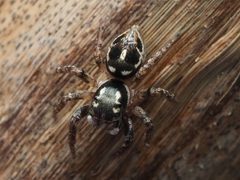
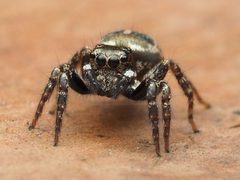
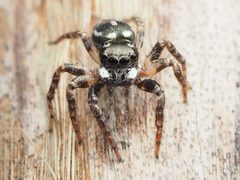
Anasaitis canosa is a small jumping spider in the Salticidae, commonly known as the twin-flagged jumping spider. It is recognized by the paired white or pale flag-like markings on its , which give the its . The species is native to the southeastern United States and has been introduced to Cuba. Like other salticids, it is an active visual hunter that does not build webs to capture prey.
Pronunciation
How to pronounce Anasaitis canosa: //ænəˈsaɪtɪs kəˈnoʊsə//
These audio files are automatically generated. While they are not always 100% accurate, they are a good starting point.
Identification
Distinguished from other small jumping spiders by the distinctive paired white flag-like markings on the . Similar Corythalia species may share abdominal patterning but differ in arrangement details and preference. Distinguished from Habronattus and Phidippus by smaller size, less vivid coloration, and specific pattern of paired pale spots rather than stripes or bands. The combination of dark body with two pairs of discrete white dorsal abdominal spots is diagnostic.
Images
Habitat
Found in leaf litter, on tree trunks, and on low vegetation in wooded and semi-open . Frequently observed on the ground or on vertical surfaces such as fence posts and building walls. Prefers humid, shaded microhabitats with structural complexity.
Distribution
Native to southeastern United States (Florida, Georgia, Alabama, Mississippi, Louisiana, South Carolina, North Carolina, Tennessee, Texas). Established introduced in Cuba. Records suggest expanding range or human-mediated to Caribbean.
Seasonality
active year-round in southern parts of range; peak activity spring through fall in northern portions. Multiple per year likely in warmer climates.
Behavior
Active hunter that relies on vision and jumping ability to capture prey. Performs characteristic salticid visual scanning with large . Males exhibit complex involving visual signals and leg movements. Constructs small silk retreats for molting and -laying, but does not build capture webs.
Ecological Role
of small arthropods in leaf litter and ground-level . Contributes to regulation of insect in forest floor and edge .
Human Relevance
Occasionally enters human structures but not considered a pest. Bite not considered medically significant; venom mild relative to body size. Sometimes encountered by hikers and naturalists due to ground-dwelling habits.
Similar Taxa
- Corythalia spp.Share similar size and some abdominal patterning; distinguished by different structure and preferences (Corythalia more often arboreal)
- Habronattus spp.Similar small size and ground-dwelling habits; distinguished by male ornamentation (Habronattus males often have bright leg or coloration) and different abdominal pattern
- Phidippus audaxLarger jumping spider with bold white spot on ; distinguished by single spot versus paired flag markings and larger body size
More Details
Taxonomic History
has undergone multiple generic transfers, previously placed in Attus, Salticus, Corythalia, and Eris before current placement in Anasaitis. Generic limits within these salticid groups remain subject to revision based on molecular data.
Etymology
Specific epithet 'canosa' likely refers to the grayish-white (Latin 'canus') color of the flag markings. 'twin-flagged' directly references the paired abdominal markings.