Pardosa saxatilis
(Hentz, 1844)
Pardosa saxatilis is a of wolf spider in the Lycosidae, found in the United States and Canada. It belongs to the Pardosa, commonly known as "thin-legged wolf spiders," which are among the most abundant wolf spiders in North America. The species name "saxatilis" (meaning "of rocks" or "rock-dwelling") suggests an association with rocky . Like other members of its genus, it is a small to medium-sized active hunter.
Pronunciation
How to pronounce Pardosa saxatilis: //pɑːrˈdoʊ.sə sækˈsætɪˌlɪs//
These audio files are automatically generated. While they are not always 100% accurate, they are a good starting point.
Identification
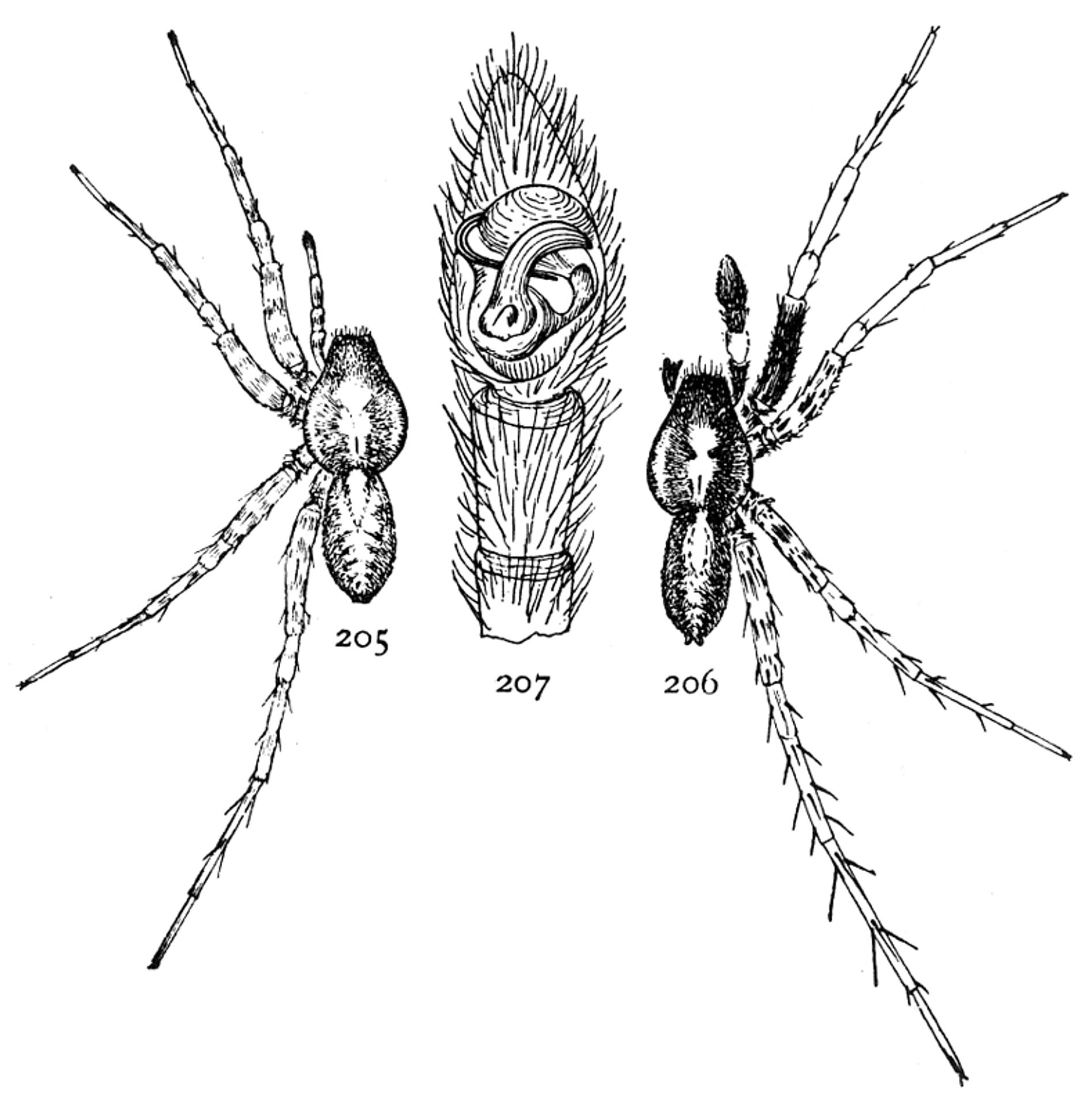
As a member of the Pardosa, P. saxatilis can be distinguished from other wolf spider genera by its long leg spines that are nearly perpendicular to the leg axis (most other wolf spiders have shorter spines more parallel to the leg surface). The hind pair of legs is notably long, making the spines on this pair easier to observe. Pardosa collectively have a higher than most other wolf spiders, with nearly vertical sides of the . Species-level identification requires microscopic examination of genitalia: females have a paired genital opening (), while males have highly modified resembling small boxing gloves. Definitive identification of P. saxatilis specifically from other Pardosa species requires examination of these structures and comparison with taxonomic keys.
Images
Habitat
The specific epithet "saxatilis" indicates a rock-associated lifestyle. Based on -level patterns, Pardosa are often abundant around water (streambeds, wetlands, lake beaches), in wooded areas (forest floors, leaf litter, logs), fields, and at high elevations in mountains. Some Pardosa species occupy multiple types.
Distribution
United States and Canada.
Behavior
As a wolf spider (Lycosidae), P. saxatilis is an active hunter that does not build webs to capture prey. Like other Pardosa , it is likely and fast-moving.
Similar Taxa
- Other Pardosa speciesShare the same -level characteristics of long perpendicular leg spines and high . Distinguished only by microscopic examination of genitalia.
- Other Lycosidae genera (e.g., Hogna, Rabidosa, Tigrosa)Larger wolf spiders with shorter leg spines oriented more parallel to the leg surface, and lower, less steep-sided .
More Details
Taxonomic note
The was described by Nicholas Marcellus Hentz in 1844, an early American arachnologist who described many North American spider species.
Sources and further reading
- BugGuide
- Wikipedia
- GBIF taxonomy match
- iNaturalist taxon
- NCBI Taxonomy
- Catalogue of Life
- Oedipodine Rex | Beetles In The Bush
- Bug Eric: July 2015
- 2013 ESA World of Insects Calendar Selection | Beetles In The Bush
- What’s more difficult to see… | Beetles In The Bush
- More on ‘Conspicuous Crypsis’ | Beetles In The Bush