
Pardosa distincta
(Blackwall, 1846)
Pale Thin-legged Wolf spider
Pardosa distincta is a of thin-legged wolf spider in the Lycosidae, commonly known as the Pale Thin-legged Wolf spider. It occurs in the United States and Canada, with records from Alberta and British Columbia. Like other members of the Pardosa, it is a small to medium-sized active hunter. Species-level identification requires microscopic examination of genitalia.
Pronunciation
How to pronounce Pardosa distincta: //pɑːrˈdoʊsə dɪˈstɪŋktə//
These audio files are automatically generated. While they are not always 100% accurate, they are a good starting point.
Identification
Distinguished from other wolf spider by the perpendicular leg spines and elevated with vertical sides. Separated from other Pardosa by microscopic features of the male and female ; field identification to species is not reliable. The 'Pale Thin-legged Wolf spider' suggests lighter coloration than some , but this is not definitively documented.
Images
Appearance
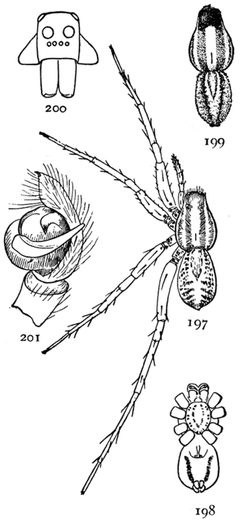
Small to medium-sized wolf spider with the characteristic elevated and nearly vertical sides of the typical of the Pardosa. Possesses long spines on the legs that are almost perpendicular to the leg axis, distinguishing it from most other wolf spiders which have shorter, more parallel spines. The hind pair of legs is relatively long, making the perpendicular spines more visible there. Body length as approximately 3-12 mm. Coloration and pattern details specific to P. distincta are not well documented in available sources.
Habitat
Specific preferences for P. distincta are not documented. Members of the Pardosa are found in diverse habitats including rocky streambeds, marshy wetlands, lake beaches, forest floors, leaf litter, fields, agricultural edges, and high-elevation mountain areas. Some Pardosa are habitat while others are more restricted.
Distribution
Recorded from the United States and Canada. Specific regional records include Alberta and British Columbia in Canada. Distribution details beyond these records are sparse.
Behavior
As a wolf spider, likely an active ground-dwelling hunter that does not build webs to capture prey. Females of the Pardosa are known to carry sacs attached to their . Specific for P. distincta are not documented.
Ecological Role
in terrestrial . As with other wolf spiders, likely contributes to regulation of insect and other small .
Similar Taxa
- Other Pardosa speciesRequire microscopic examination of genitalia for definitive separation; many occupy similar and share general
- Other Lycosidae generaDistinguished by perpendicular leg spines and elevated with vertical sides in Pardosa
More Details
Taxonomic Note
First described by Blackwall in 1846. The is part of the large Pardosa, which contains 65 species in the U.S. and 75 species north of Mexico.
Identification Challenges
The Pardosa is notoriously difficult to identify to without microscopic examination. The statement 'Identification of species hinges on microscopic examination of the genitalia' applies to this species as with all Pardosa.
Sources and further reading
- BugGuide
- Wikipedia
- GBIF taxonomy match
- iNaturalist taxon
- NCBI Taxonomy
- Catalogue of Life
- Like a Moth to a Flame: Moth Night at Bohart Museum of Entomology | Bug Squad
- Bug Eric: July 2015
- Bug Eric: City Nature Challenge 2024 Recap
- Bug Eric: First Night of Blacklighting
- Bug Eric: Wasp Wednesday: Ageniella accepta/conflicta
- Bug Eric: April 2024