
Stemonyphantes blauveltae
Gertsch, 1951
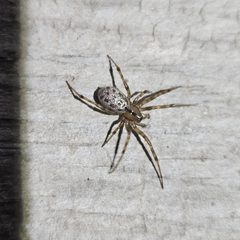
Stemonyphantes blauveltae is a of sheet-web weaving spider in the Linyphiidae, first described by Gertsch in 1951. It is a small-bodied spider distributed across northern North America, with records from multiple Canadian provinces and the United States. As a member of one of the largest spider families, it constructs horizontal sheet webs to capture prey.
Pronunciation
How to pronounce Stemonyphantes blauveltae: //stɛmɒnɪˈfæntiz blaʊˈvɛlteɪ//
These audio files are automatically generated. While they are not always 100% accurate, they are a good starting point.
Identification
Distinguishing Stemonyphantes blauveltae from requires examination of genitalic structures, particularly the male and female . The Stemonyphantes is characterized by specific morphological traits in the and genitalia that separate it from other linyphiid genera. Identification to level is not possible from general habitus alone.
Images
Distribution
Recorded from the United States and Canada, specifically from the Canadian provinces of Alberta, British Columbia, and Manitoba. The full extent of its range within North America remains incompletely documented.
Ecological Role
As a sheet-web weaving spider, it likely functions as a of small flying and crawling insects within its .
Similar Taxa
- Other Stemonyphantes speciesMorphologically similar and require genitalic examination for definitive separation; several occur in overlapping ranges in North America.
- Other Linyphiidae generaSmall body size and sheet-web construction are shared across numerous linyphiid ; precise identification depends on detailed morphological study.
More Details
Taxonomic history
The epithet 'blauveltae' honors an individual, following a common practice in arachnid of the mid-20th century.
Data limitations
Only 8 observations are recorded in iNaturalist as of the source data, indicating this is rarely encountered or underreported, or both.