
Gonatium
Menge, 1868
Species Guides
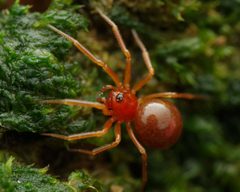
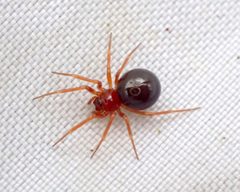
1- Gonatium crassipalpum(dwarf spider)
Gonatium is a of dwarf spiders ( Linyphiidae) comprising twenty as of 2025. The genus was established by Anton Menge in 1868 and exhibits a broad geographic distribution spanning Europe, Asia, North Africa, and North America. Species within this genus occupy diverse from Mediterranean regions to and montane environments.
Pronunciation
How to pronounce Gonatium: //ɡoʊˈneɪʃiəm//
These audio files are automatically generated. While they are not always 100% accurate, they are a good starting point.
Identification
As a of Linyphiidae, Gonatium possess the characteristic features of sheet-web weaving dwarf spiders: small body size (typically 1.5–4 mm), long and slender legs relative to body proportions, and a globose or slightly elongated . Definitive genus-level identification requires examination of male and female structures. The type species G. rubens and related species show subtle variations in abdominal patterning and leg spination that distinguish them from .
Images
Habitat
occur in varied terrestrial including forest litter, grasslands, and rocky substrates. European species such as G. rubens and G. hilare have been recorded in montane and subalpine zones, while Mediterranean species (G. occidentale, G. dayense) inhabit warmer, drier regions. North American of G. crassipalpum are documented from forested areas in the northeastern United States and Canada.
Distribution
Twenty distributed across Algeria, Bulgaria, Canada, China, France, Israel, Italy, Japan, Kazakhstan, Kenya, Korea, Macedonia, Morocco, Portugal, Romania, Russia, Spain, Turkey, and the United States. The shows highest diversity in the Palearctic region, with particular concentration in Europe and temperate Asia. Disjunct occur in East Africa (Kenya: G. petrunkewitschi) and North America (G. crassipalpum).
Similar Taxa
- LinyphiaBoth are Linyphiidae with sheet-web building , but Linyphia are generally larger with more prominent abdominal markings and construct more conspicuous horizontal sheet webs in vegetation rather than ground-level microhabitats.
- ErigoneAnother dwarf spider with overlapping distribution and preferences; Erigone typically show distinct male cheliceral modifications and different epigynal requiring microscopic examination for separation.
- OedothoraxShares small body size and ground-dwelling habits; Oedothorax often exhibit more pronounced in abdominal shape and possess characteristic tibial in males not found in Gonatium.
More Details
Taxonomic History
The was established by German arachnologist Anton Menge in 1868 based on European material. The type Gonatium rubens was originally described by Blackwall in 1833 as Erigone rubens. The genus has remained relatively stable taxonomically, though species limits continue to be refined through modern morphological and molecular studies. The recently described G. tridentatum (2025) from China indicates ongoing discovery of Asian diversity.
Biogeographic Patterns
The distribution pattern suggests multiple events or vicariance scenarios: a core Palearctic radiation with peripheral isolates in North America (G. crassipalpum) and East Africa (G. petrunkewitschi). The presence of G. japonicum and G. nipponicum in the Russian Far East, China, Korea, and Japan indicates trans-Beringian or trans-continental Asian connections.