
Cesonia bilineata
(Hentz, 1847)
Two-lined Stealthy Ground Spider
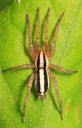
Cesonia bilineata is a small ground spider in the Gnaphosidae, first described by Nicholas Marcellus Hentz in 1847. Despite its suggesting terrestrial habits, this is frequently observed climbing vegetation and scaling walls. It has been documented preying on spiderlings of other spider species, including in nursery webs of Pisaurina mira and Peucetia viridans. The species is widespread in eastern North America.

Pronunciation
How to pronounce Cesonia bilineata: /sɛˈsoʊniə ˌbaɪlɪˈniːətə/
These audio files are automatically generated. While they are not always 100% accurate, they are a good starting point.
Identification
Distinguished from other Cesonia by the paired longitudinal abdominal stripes. The combination of small size, ground spider characteristics ( arrangement, structure), and arboreal habits helps separate it from true terrestrial gnaphosids. Females can be recognized by their overall proportions and markings when found in vegetation.
Images
Appearance
females measure 4.3–7.0 mm in body length, with males being smaller. The spider has a compact body with relatively short legs compared to some other ground spiders. The 'two-lined' refers to distinctive longitudinal markings on the .
Habitat
Occupies diverse including forests, prairies, and urban areas. Frequently found climbing on foliage, twigs, and walls rather than strictly ground-dwelling. Has been observed in nursery webs of other spiders well above ground level.
Distribution
Eastern United States from New England south to the Florida panhandle and west to Nebraska. Also recorded in Canada (Manitoba, Saskatchewan) and Mexico. North American distribution confirmed by GBIF records.
Seasonality
Active during warmer months. Females lay in summer, depositing egg sacs under stones or leaves.
Diet
Predatory on other spiders. Has been observed in nursery webs of Pisaurina mira and Peucetia viridans, apparently feeding on spiderlings. Known to attack spider prey from behind.
Host Associations
- Pisaurina mira - preyObserved in nursery web, likely predating on spiderlings
- Peucetia viridans - preyObserved in nursery web by Willey and Adler (1989)
Life Cycle
Females produce sacs in summer, placed under stones or leaves. Spiderlings emerge from egg sacs and disperse. Development includes typical spider stages: egg, spiderling, , .
Behavior
Highly agile climber, frequently found on vegetation and walls rather than ground. Has been observed entering nursery webs of other spider , where it likely preys on spiderlings. Attacks spider prey from behind.
Ecological Role
, particularly of other spiders. May function as a control agent for spider that build nursery webs.
Human Relevance
Not medically significant. Too small to be of concern to humans. May occasionally be encountered in urban areas due to its wall-climbing .
Similar Taxa
- Other Cesonia speciesShare characteristics but differ in abdominal pattern; C. bilineata specifically has two longitudinal lines
- Other GnaphosidaeMany ground spiders are strictly terrestrial; C. bilineata distinguished by frequent arboreal habits and specific markings
- Pisaurina miraMay be confused when found in same , but P. mira is much larger (12.5–16.5 mm) with different body proportions and nursery web guarding
Misconceptions
The 'ground spider' is misleading for this , which is frequently found climbing vegetation and walls rather than remaining on the ground.
More Details
Predation behavior
Evidence for on guarded spiderlings is circumstantial but suggestive. Observations include plump females found in nursery webs with shed spiderling present. The ' small size and agility may allow it to exploit nursery webs without triggering maternal defensive responses from larger spiders.
Taxonomic history
First described by Nicholas Marcellus Hentz in 1847, a prominent early American arachnologist. The has remained in the Cesonia since description.
Sources and further reading
- BugGuide
- Wikipedia
- GBIF taxonomy match
- iNaturalist taxon
- NCBI Taxonomy
- Catalogue of Life
- Meloidae Holdings | Entomology Research Museum
- Bug Eric: October 2014
- Midget male meloid mates with mega mama | Beetles In The Bush
- Bug Eric: New Mexico Dragonfly Blitz - Day 1
- Bug Eric: City Nature Challenge 2023 Recap
- P.M. Pollinators: Study Shines Light on Nocturnal Insects' Role in Apple Production