
Callilepis pluto
Banks, 1896
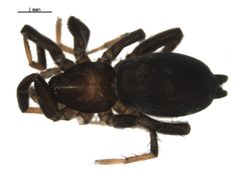
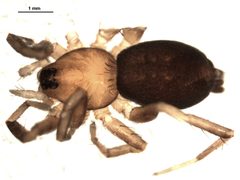
Callilepis pluto is a of ground spider in the Gnaphosidae, first described by Banks in 1896. The species is found in the United States and Canada. As a member of the Gnaphosidae, it possesses the characteristic cylindrical at the tip of the typical of this family. The Callilepis includes species that can be distinguished from similar genera such as Sergiolus by subtle differences in genitalia.
Pronunciation
How to pronounce Callilepis pluto: /kæˈlɪləpɪs ˈpluːtoʊ/
These audio files are automatically generated. While they are not always 100% accurate, they are a good starting point.
Identification
The Callilepis belongs to the Gnaphosidae, whose members are distinguished by prominent cylindrical at the tip of the . Within Gnaphosidae, Callilepis is described as an genus similar to Sergiolus, with separation between these genera requiring examination of genital structures: the in females and in males. No specific diagnostic features for distinguishing C. pluto from other Callilepis are documented in available sources.
Images
Distribution
United States and Canada. GBIF records indicate presence in both countries, with distribution data showing occurrences across North America.
Similar Taxa
- SergiolusBoth are described as members of Gnaphosidae with bold coloration; they are distinguished by subtle differences in genitalia ( in females, in males).
More Details
Taxonomic context
The Callilepis is noted in arachnological literature as containing within the ground spider Gnaphosidae, though detailed species-level information for C. pluto remains limited in publicly available sources.
Sources and further reading
- BugGuide
- Wikipedia
- GBIF taxonomy match
- iNaturalist taxon
- NCBI Taxonomy
- Catalogue of Life
- In Search of the World's Biggest Bee: How It Came to 'Bee' | Bug Squad
- How to import occurrence records into manuscripts from GBIF, BOLD, iDigBio and PlutoF | Blog
- beetle species | Blog
- Bug Eric: Ground Spiders, Sergiolus
- Truffles and tulips: Pensoft and the 12th International Mycological Congress |