
Falconina gracilis
(Keyserling, 1891)
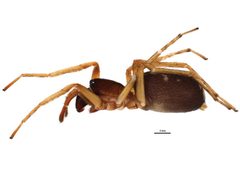
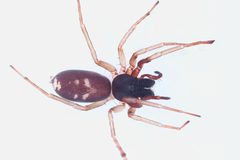
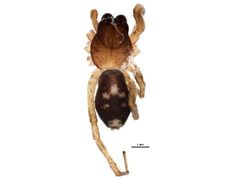
Falconina gracilis is a of true spider in the Corinnidae, a group commonly known as ground spiders or -mimicking spiders. It is native to South America, with established in Brazil, Paraguay, and Argentina. The species has been introduced to the United States and Cuba, where it occurs as a non-native species. Records from GBIF also indicate presence in Peru, Bolivia, and Uruguay.
Pronunciation
How to pronounce Falconina gracilis: //fælkoʊˈniːnə ˈɡræsɪlɪs//
These audio files are automatically generated. While they are not always 100% accurate, they are a good starting point.
Images
Distribution
Native to South America: Brazil, Paraguay, Argentina, Peru, Bolivia, and Uruguay. Introduced to the United States and Cuba. Within Brazil, recorded from multiple states including Amazonas (BR-AM), Bahia (BR-BA), Ceará (BR-CE), Distrito Federal (BR-DF), Mato Grosso do Sul (BR-MS), Pará (BR-PA), Pernambuco (BR-PE), Piauí (BR-PI), Rio de Janeiro (BR-RJ), Rio Grande do Norte (BR-RN), Rio Grande do Sul (BR-RS), and São Paulo (BR-SP).
Human Relevance
Introduced to the United States and Cuba, making it a of interest for studies on non-native spider establishment and spread.
More Details
Taxonomic History
Originally described by Keyserling in 1891. The has been well-documented in South American arachnological surveys and is represented by over 3,600 observations on iNaturalist.
Introduction Pathway
The mechanism of introduction to the United States is not documented in available sources. As a ground-dwelling spider, it may have been transported via commerce, agriculture, or horticultural trade.