
Neoseiulus
A.M. Hughes, 1948
Neoseiulus is a of predatory mites in the Phytoseiidae, widely recognized as important agents in agricultural systems. within this genus prey on spider mites and other small pests, making them valuable components of programs. The genus includes commercially significant species such as Neoseiulus californicus and Neoseiulus fallacis, which are mass-reared and released in crop protection programs across multiple continents. Research on Neoseiulus species has focused on their reproductive , prey consumption patterns, and responses to environmental stressors.
Pronunciation
How to pronounce Neoseiulus: /niː.oʊˈsaɪ.jʊləs/
These audio files are automatically generated. While they are not always 100% accurate, they are a good starting point.
Identification
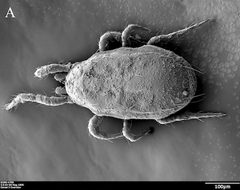
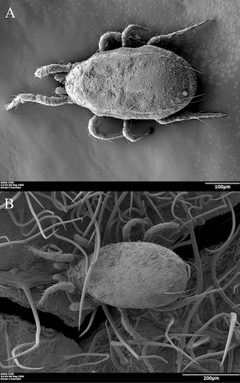
Neoseiulus are distinguished from other phytoseiid by a combination of morphological characters including setal patterns on the shield and specific features of the spermathecal structure. Accurate identification to species level typically requires microscopic examination of specimens and specialized taxonomic expertise. Species within Neoseiulus may be differentiated from the closely related genus Amblyseius by subtle morphological differences in dorsal setation and plate structure.
Images
Habitat
Neoseiulus inhabit agricultural crops, orchards, and natural vegetation where their prey occur. They are commonly found on the leaves of plants, particularly in microhabitats such as leaf domatia—small cavities or tufts of hair that provide shelter. Laboratory studies indicate preference for glabrous (smooth) leaves or those with specialized shelters over leaves with dense glandular trichomes.
Distribution
Distribution records exist from Denmark, Norway, and Sweden. Individual within the have broader distributions: Neoseiulus californicus and Neoseiulus fallacis occur in western North America; Neoseiulus womersleyi and Neoseiulus longispinosus have been studied in Asian contexts. Release programs using Neoseiulus species have been implemented in more than 50 countries worldwide, including extensive use in Brazil on over 15,000 hectares of strawberries and flowers.
Diet
Predatory mites in the Neoseiulus feed on spider mites (Tetranychidae), including and active stages of Tetranychus urticae. Laboratory studies demonstrate that consumption of Tetranychus urticae eggs varies with egg age, with older eggs (48-72 hours) consumed at higher rates than younger eggs (0-24 hours) under starvation conditions. Some may supplement diet with pollen and other non-prey food sources when prey is scarce, though this varies by species.
Life Cycle
Development includes , larva, , deutonymph, and stages. Female deutonymphs are relatively inactive and are tended by males prior to mating. Males exhibit promiscuous tending toward multiple female deutonymphs. Interspecific crosses between some Neoseiulus produce sterile or non-viable offspring, indicating reproductive isolation mechanisms.
Behavior
Males actively seek and tend female deutonymphs, remaining with them until molting to adulthood and mating. Copulation duration directly influences sperm transfer and subsequent female , with longer copulations resulting in greater production. Starvation increases prey consumption rates compared to well-fed individuals. Some exhibit intraguild interactions with other phytoseiid mites. show varying levels of ambulatory activity between species.
Ecological Role
Predatory mites in this function as agents that suppress of phytophagous mites in agricultural and natural . They occupy intermediate trophic positions, consuming herbivorous mites while potentially serving as prey for larger . Their presence in cropping systems can reduce dependence on chemical .
Human Relevance
Neoseiulus are commercially mass-produced and sold as agents for in greenhouse and field crops. Neoseiulus californicus ranks as the second most researched predatory mite in scientific literature. Release programs have been established in Brazil, Europe, Asia, Africa, and the Americas. Effectiveness depends on proper timing of releases, avoidance of incompatible , and provision of suitable conditions including alternative food sources such as pollen.
Similar Taxa
- AmblyseiusBoth belong to Phytoseiidae and contain predatory mites used in ; distinguished by subtle morphological differences in setation and plate structure.
- PhytoseiulusBoth contain predatory mites targeting spider mites; Phytoseiulus persimilis is the most researched predatory mite, while Neoseiulus californicus ranks second. Phytoseiulus are generally more specialized compared to the broader dietary range of many Neoseiulus species.
Sources and further reading
- BugGuide
- Wikipedia
- GBIF taxonomy match
- iNaturalist taxon
- NCBI Taxonomy
- Catalogue of Life
- Neoseiulus fallacis - Entomology Today
- Biological Control in Brazil is Used on an Area that is Larger than Belgium
- How the Mighty Mite Conquered the Heart of One Entomologist
- This Predatory Mite is a Rising Star in Pest Management
- Mating, cross-mating and related behaviours of Neoseiulus californicus and Neoseiulus fallacis (Acari: Phytoseiidae)
- Copulation duration, sperm transfer and reproduction of the two closely related phytoseiid mites, Neoseiulus womersleyi and Neoseiulus longispinosus (Acari: Phytoseiidae)
- Influence of Prey Egg Age on The Consumption Capacity of Amblyseius swirskii and Neoseiulus californicus (Acari: Mesostigmata: Phytoseiidae) Amblyseius swirskii ve Neoseiulus californicus (Mesostigmata: Phytoseiidae)’un Tüketim Kapasitesine Avın Yumurta Yaşının Etkisi
- Chromosome-level genome assembly of Neoseiulus longispinosus (Phytoseiidae).
- Changes in Transcriptome and Functional Evaluation of Heat Shock Protein 70 in Predatory Mite Neoseiulus californicus (Hughes) in Response to Extreme High Temperature.
- Intraguild Predation and Chemical Cue Responses Between Phytoseiulus persimilis and Neoseiulus californicus in Laboratory Assays.