
Tarsonemidae
thread-footed mites, white mites
Genus Guides
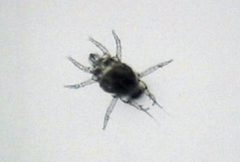
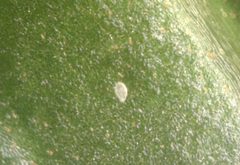
1is a of mites in the order Trombidiformes, commonly known as thread-footed mites or white mites. The family exhibits diverse feeding habits: most feed on fungal mycelia or algal bodies, while a limited number of (Steneotarsonemus, Polyphagotarsonemus, Phytonemus, Floridotarsonemus, and Tarsonemus) feed on higher plants. Some tarsonemids are associated with insects, including of bees (), associates of leaf-footed bug glands, and attachments to wings. Several species are significant agricultural pests, notably the broad mite (Polyphagotarsonemus latus) and cyclamen mite (Steneotarsonemus pallidus).
Pronunciation
How to pronounce Tarsonemidae: /ˌtɑrsəˈnɛmɪdiː/
These audio files are automatically generated. While they are not always 100% accurate, they are a good starting point.
Images
Habitat
Tarsonemids occupy diverse reflecting their varied feeding strategies. Plant-feeding are found on growing points and young foliage where walls are thin and easily pierced. Fungivorous species inhabit environments with fungal mycelia, including stored grain facilities and decomposing wood. Some species are associated with bark beetle galleries in coniferous forests. Others occur in greenhouses on cultivated crops including peppers, cucumbers, aubergines, and citrus. Insect-associated species occupy specialized : Acarapini parasitize Apis bees, Coreitarsonemini inhabit odoriferous glands of leaf-footed bugs (Coreidae), and Podotarsonemini attach to wings of tetrigid grasshoppers.
Distribution
Worldwide distribution. Documented from North America (first description of Polyphagotarsonemus latus from Washington, D.C., USA), Europe (Greece, Britain, Norway, Crimea/Ukraine), Asia (Japan), and South America (Brazil). GBIF records indicate presence in Denmark, Norway, Sweden, and the United States (Vermont).
Diet
Most feed on thin-walled mycelia of fungi; some feed on algal bodies. Plant-feeding species in Steneotarsonemus, Polyphagotarsonemus, Phytonemus, Floridotarsonemus, and Tarsonemus pierce of higher plants. Polyphagotarsonemus latus and Steneotarsonemus pallidus uniquely inject toxins during feeding that induce proliferation of thin-walled cells, allowing them to feed on older leaves. Tarsonemus granarius feeds on fungi that deteriorate stored grain.
Host Associations
- higher plants - herbivorelimited to Steneotarsonemus, Polyphagotarsonemus, Phytonemus, Floridotarsonemus, and Tarsonemus; most confined to new growth with thin walls
- fungi - fungivoreprimary food source for majority of ; includes mycelia of fungi deteriorating stored grain
- algae - possible herbivorealgal bodies mentioned as possible food source
- Apis bees - Acarapini tribe, including , a notable pest of honey bees
- leaf-footed bugs (Coreidae) - commensalCoreitarsonemini inhabit odoriferous glands
- tetrigid grasshoppers - phoreticPodotarsonemini attach to wings
- bark beetles (Scolytidae) - phoreticmultiple Tarsonemus associated with bark beetles in coniferous forests
- Xylodiplosis gall midges - /associatePseudotarsonemoidini associated with gall midges in wood
- mango - herbivoreoriginal of Polyphagotarsonemus latus description
- pepper - herbivoregreenhouse pest, especially in Crete and Mediterranean
- citrus - herbivore for multiple tarsonemid in Florida and Greece
- cucumber - herbivoregreenhouse in Crete
- aubergine - herbivoregreenhouse in Crete
- cotton - herbivorefirst recorded in Greece (1969)
- tea - herbivorerecorded of broad mite
- beans - herbivorerecorded of broad mite
- tomatoes - herbivorerecorded of broad mite
- coffee - herbivorerecorded of broad mite
- avocado - herbivorerecorded of broad mite
- jute - herbivorerecorded of broad mite
- gerbera - herbivorerecorded of broad mite
- fuchsia - herbivorerecorded of broad mite
- jasmine - herbivorerecorded of broad mite
- magnolia - herbivorerecorded of broad mite
- stored grain - /fungivoreTarsonemus granarius occurs in granaries in Canada, Japan, and British Isles
- Prunus spp. - herbivore of Tarsonemus pruni in Greece
- Gramineae plants - herbivore of Steneotarsonemus hordei in Greece
Behavior
Plant-feeding are typically confined to areas of new growth where walls are thin and easily pierced. Polyphagotarsonemus latus and Steneotarsonemus pallidus exhibit unique feeding : they inject toxins (presumably salivary gland origin) during feeding, causing proliferation of thin-walled cells surrounding feeding sites, resulting in stunted, puckered, and twisted leaves. Some species exhibit phoretic associations with insects, using beetles or other arthropods for transport to new . Tarsonemus species associated with bark beetles are transported to new trees via these beetles.
Ecological Role
Fungivorous contribute to decomposition by feeding on fungal mycelia. Some species in stored grain facilities may disseminate fungi that deteriorate grain. Insect-associated species occupy commensal, mutualistic, or parasitic roles: is a significant of honey bees. Phoretic associations with bark beetles may facilitate mite in forest . Agricultural pest species damage crop plants through direct feeding and toxin injection, affecting plant growth and yield.
Human Relevance
Several are significant agricultural pests. The broad mite (Polyphagotarsonemus latus) and cyclamen mite (Steneotarsonemus pallidus) cause substantial damage to greenhouse crops including peppers, cucumbers, tomatoes, and ornamentals. include distorted growing points, down-curled leaf margins, crinkled leaves, and distorted leaf , dark green coloration, cracked and russet fruits, and stunted growth resembling weedkiller damage. () is a notable pest of honey bees. Control methods include chemical acaricides (endosulfan, dicofol), with methyl bromide or 1,2-dibromoethane for planting stock, and using fungi ( bassiana, Metarhizium anisopliae, fumosoroseus) and predatory phytoseiid mites (Neoseiulus species).
Sources and further reading
- BugGuide
- Wikipedia
- GBIF taxonomy match
- iNaturalist taxon
- NCBI Taxonomy
- Catalogue of Life
- Tarsonemidae Archives - Entomology Today
- Bug Eric: A One Millimeter Mystery
- Of Mites and Men: A Visit to the USDA Electron & Confocal Microscopy Unit
- How One Entomologist Became a Detective of 'Pest Mysteries'
- New Tarsonemids Associated with Bark Beetles (Acarina: Tarsonemidae)
- Broad Mite, Polyphagotarsonemus latus (Banks) (Arachnida: Acari: Tarsonemidae)
- Two new species of the family Tarsonemidae (Acari: Prostigmata) from Greece
- Two new species of Tarsonemus (Acari: Tarsonemidae) associated with bark beetles (Coleoptera: Scolytidae) from Crimea, Ukraine
- New Tarsonemid Mites Associated with Citrus in Florida (Acarina: Tarsonemidae)
- First record of Polyphagotarsonemus latus (Banks 1904) (Αcari: Tarsonemidae) on greenhouse peppers in Crete
- A NEW SPECIES OF TARSONEMUS FROM STORED GRAIN (ACARINA: TARSONEMIDAE)