
Camerobiidae
Southcott, 1957
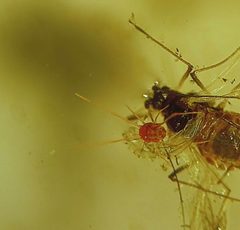
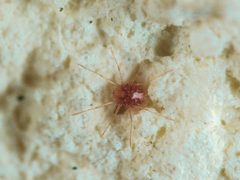
Camerobiidae is a of prostigmatan mites within the superfamily Raphignathoidea, characterized by distinctly long and slender stilt-like legs. The family includes several , notably Camerobia, Neophyllobius, and Tycherobius, with recorded from Australia, Türkiye, and fossil deposits in Eocene Baltic amber. These mites are associated with aboveground vegetation and various litter . The fossil record was previously limited to a single species but has been expanded with recent descriptions of additional fossil .
Pronunciation
How to pronounce Camerobiidae: //ˌkæməˌroʊˈbaɪ.i.aɪˌdi.iː//
These audio files are automatically generated. While they are not always 100% accurate, they are a good starting point.
Identification
Members of Camerobiidae are distinguished by their exceptionally long and slender, stilt-like legs—a morphological signature of the . The Camerobia is recognized by distinctive dorsocentral setal arrangements, with -level identification often depending on the presence or absence of specific setal pairs such as the central setae (ex). The genus Tycherobius can be identified using characters established in taxonomic keys to . Fossil species of Neophyllobius are identified from amber inclusions based on leg proportions and prodorsal shape.
Images
Habitat
Aboveground vegetation; grasstree litter; forest litter; wet-sandy heath litter; plantation litter (African Mahogany). Specific associations vary by and .
Distribution
Australia (Queensland: Brisbane, Cooloola, Far North Queensland); Türkiye; fossil record from Eocene Baltic amber.
Diet
Hunts for other small .
Behavior
Predatory hunting of small in aboveground vegetation.
Similar Taxa
- StigmaeidaeBoth belong to the superfamily Raphignathoidea and share morphological features such as cupule-like depressions in the anogenital region; Camerobiidae is distinguished by its stilt-like legs.
Sources and further reading
- BugGuide
- Wikipedia
- GBIF taxonomy match
- iNaturalist taxon
- NCBI Taxonomy
- Catalogue of Life
- A review of the genus Tycherobius (Acari: Camerobiidae), with descriptions of four new species from Australia
- New fossil stilt-legged mites ofNeophyllobiusBerlese, 1886 (Acariformes, Camerobiidae) from Eocene Baltic amber
- Contribution to the genus Camerobia Southcott (Acariformes: Camerobiidae): description of C. exnuda sp. n. from Türkiye
- New Genus and New Subgenera of Camerobiid Mites (Acari: Prostigmata: Camerobiidae) with a Key to World Species of the Genus.