
Cheyletidae
Leach, 1815
Cheyletid mites
Genus Guides
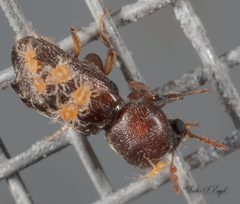
1Cheyletidae is a of predatory and parasitic mites in the order Trombidiformes. Some , notably in the Cheyletiella, are of mammals and birds causing cheyletiellosis (" dandruff"). Most species are free-living found in diverse including soil, forest litter, animal nests, house dust, under bark, and on foliage. They feed on other mites, , and small arthropods. Several species have been evaluated as agents for agricultural and stored-product pests.
Pronunciation
How to pronounce Cheyletidae: /kaɪˈlɛtɪdiː/
These audio files are automatically generated. While they are not always 100% accurate, they are a good starting point.
Identification
Cheyletidae are distinguished from other prostigmatid mites by the combination of short stylet-like and large pincer-like palps with a strong tibial claw extending beyond the short . The palp tarsus bears distinctive comb-like and sickle-like setae. The variable number of plates (zero to multiple) and the presence of specialized leg modifications in some (e.g., elongated legs I in Cheletonella) provide additional diagnostic characters. Parasitic in Cheyletiella may be recognized by association and location on mammalian skin.
Images
Appearance
Small mites with distinctive cheliceral and palpal . Short stylet-like . Large pincer-like palps with short palp bearing comb-like and sickle-like setae on the part of the palp tibia. Palp tibia has a strong claw extending beyond the palp tarsus. Body may have zero, one, or multiple plates. Some (e.g., Cheletonella) have unusually long first legs used in prey capture.
Habitat
Highly diverse: free-living occur in soil, forest litter, animal nests, house dust, under tree bark, and on foliage. Some species are associated with specific substrates such as straw or citrus groves. Parasitic species occur on the skin of mammals and birds. Some species have been found in corpses.
Distribution
. Documented from North America (USA, including Florida), South America (Brazil), Europe (Denmark, Norway, Sweden, Turkey), Africa (Southern Africa, Belgian Congo region), and Asia (Malay Peninsula).
Diet
Predatory feed on other mites, , and small arthropods including spider mites, tenuipalpid mites, , and insect . Some species are of mammals and birds, feeding on skin debris and tissue fluids.
Host Associations
- Mammals - Cheyletiella cause cheyletiellosis (" dandruff")
- Birds - Some parasitic on birds
- Pinnaspis aspidistrae - Cheletogenes ornatus preys on this insect in Brazil
- Two-spotted spider mite - Hemicheyletia wellsina maintained on this prey in laboratory
- Orchid pests - Hemicheyletia wellsina assumed to feed on spider mites, tenuipalpid mites, and on orchids
Life Cycle
Development includes , nymphal, and stages. In Cheletogenes ornatus at 28±5°C, duration was 40.6 days for males and 31 days for females. Females have 2 nymphal stages; males have 1 nymphal stage. in some is with males seldom produced.
Behavior
Predatory use modified palps and, in some , elongated legs to capture prey. Some species show differential compared to their prey. Intraspecific morphological variation in palp tibial claw teeth number has been documented.
Ecological Role
in soil, litter, and foliage . agents of pest mites and insects in agricultural systems; some evaluated for control of scale insects, spider mites, and stored-product . Parasitic species act as mild of mammals and birds.
Human Relevance
Some (Cheyletiella) cause cheyletiellosis in domestic animals, a dermatitis sometimes called " dandruff" due to visible mite movement. This condition is zoonotic and can affect humans in contact with infested animals. Other species are studied and used as agents for agricultural pests.
Similar Taxa
- Tetranychidae (spider mites)Cheyletidae prey on spider mites and may co-occur on plants; distinguished by predatory palpal and active hunting versus herbivorous feeding and web-spinning in spider mites
- MyobiidaeAlso includes parasitic mites of birds; distinguished by cheyletid palpal and cheliceral characters
More Details
Morphological Variation
Cheletomorpha lepidopterorum exhibits intraspecific variation in palp tibial claw teeth number, with normally one large basal tooth in females and one to four teeth in males. Turkish specimens showed unilateral and bilateral numerical variations.
Pesticide Tolerance
Cheletogenes ornatus showed high to several (methyl parathion, malathion, cyhexatin, zineb, sulfur) that were toxic to its prey Pinnaspis aspidistrae, suggesting potential for .
Biological Control Potential
Hemicheyletia wellsina was deemed unlikely to be effective as an introduced in agricultural crops due to requirements for high pest densities, but may contribute to natural in with lower pest densities.
Sources and further reading
- BugGuide
- Wikipedia
- GBIF taxonomy match
- iNaturalist taxon
- NCBI Taxonomy
- Catalogue of Life
- A Long-Legged Mite Species from Turkey: Cheletomorpha lepidopterorum (Shaw) (Acari: Cheyletidae) Türkiye’den Uzun Bacaklı Bir Akar Türü: Cheletomorpha lepidopterorum (Shaw) (Acari: Cheyletidae)
- Morphology, biology and pesticide tolerance ofChelotogenes ornatus [Acari: Cheyletidae]
- Cheyletid mites associated with plants in the Malay Peninsula, with description of a new species (Acarina: Cheyletidae).
- The characteristics of lifespan in Cheyletidae and its response to environmental factors
- New mite parasites of African birds (Myobiidae, Cheyletidae)
- Wellsina Mite Hemicheyletia wellsina (De Leon) (Arachnida: Acari: Cheyletidae)
- Cheyletidae (Acarina: Trombidiformes) Associated with Citrus in Florida
- Comparative Assessment of the Potential of Xylocoris flavipes (Hemiptera: Anthocoridae) and Two Cheyletus spp. (Trombidiformes: Cheyletidae) for Managing Liposcelis decolor (Psocodea: Liposcelididae).