
Trombellidae
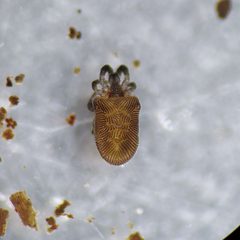
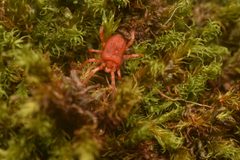
Trombellidae is a of prostigmatid mites within the superfamily Trombiculoidea. These mites are closely related to chiggers (Trombiculidae) and share the characteristic parasitic larval stage, though they are far less studied than their medically important relatives. The family is distinguished by particular morphological features of the larval gnathosoma and setation patterns. trombellids are free-living , while larvae are of arthropods.
Pronunciation
How to pronounce Trombellidae: /trɒmˈbɛlɪˌdiː/
These audio files are automatically generated. While they are not always 100% accurate, they are a good starting point.
Identification
Larvae require slide mounting and microscopic examination. Key characters include: shape (often pentagonal or trapezoidal), number and arrangement of sensillae, and details of the gnathosomal base. distinguished from related by the combination of heavily sclerotized , leg chaetotaxy, and presence of particular lyrifissures. Separation from Trombiculidae relies on larval scutal setae and cheliceral rather than association.
Images
Habitat
inhabit soil, leaf litter, and decaying organic matter in terrestrial environments. Larvae occur on or near arthropods. Specific microhabitat preferences are poorly documented due to limited study.
Distribution
Recorded from multiple continents including North America, South America, Europe, and Australia. Distribution records are sparse and likely reflect limited sampling effort rather than actual rarity.
Seasonality
activity patterns unknown; larval likely seasonal depending on availability. Insufficient data for reliable .
Diet
are predatory, feeding on small and possibly in soil and litter. Larvae are , feeding on of including insects and possibly other arachnids.
Host Associations
- Orthoptera - larval documented group for some
- Coleoptera - larval documented group for some
Life Cycle
Trombellidae exhibits the typical parasitengone : , inactive pre-larva, parasitic larva, inactive , active predatory deutonymph, inactive tritonymph, and active predatory . Only the larval stage is parasitic; all post-larval instars are free-living .
Behavior
are fast-moving, active in soil and litter. Larvae exhibit -seeking and attach to hosts to feed. Specific behavioral details are largely unstudied.
Ecological Role
function as in soil , potentially regulating of small . Larvae act as that may impact , though population-level effects are unknown. Role in nutrient cycling through soil likely minor compared to other mesofauna.
Human Relevance
Similar Taxa
- TrombiculidaeShared superfamily Trombiculoidea; larvae also ectoparasitic. Distinguished by larval scutal setation, cheliceral blade structure, and typically different associations (Trombiculidae more often on vertebrates). of Trombiculidae generally less heavily sclerotized.
- LeeuwenhoekiidaeRelated prostigmatid with parasitic larvae. Larvae of Leeuwenhoekiidae have distinct scutal shapes and are often associated with different groups; differ in leg chaetotaxy and cuticular .
More Details
Taxonomic uncertainty
Trombellidae contains relatively few described (approximately 20–30), and the has undergone periodic revision. Some have been moved between Trombellidae and related families, reflecting ongoing debate about phylogenetic relationships within Trombiculoidea. The type genus is Trombella.
Research gap
The is severely understudied compared to Trombiculidae. Most are known from few specimens, and biological data ( ranges, specificity, geographic distribution) are fragmentary. Modern molecular has not substantially addressed this family.