
Tanaupodidae
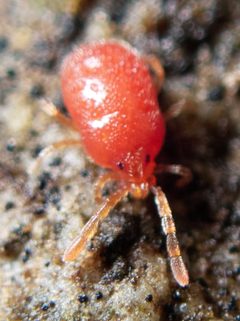
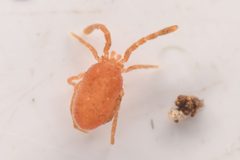
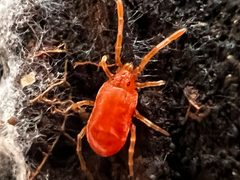
Tanaupodidae is a of mites in the order Trombidiformes, suborder Parasitengona, considered to form one of the basal clades of this group. The family is considered enigmatic due to limited knowledge of its and diversity. Larvae of at least some are parasitic on , including aphids and springtails. The family includes approximately 13 genera, with fossil records from Baltic amber indicating an ancient evolutionary history.
Pronunciation
How to pronounce Tanaupodidae: //ˌtænəˈjuːpədaɪ//
These audio files are automatically generated. While they are not always 100% accurate, they are a good starting point.
Identification
Tanaupodidae can be distinguished from other parasitengone mites by specific morphological features, including an elongate seta on the surface of III in some , a characteristic shared with the genus Amphotrombium. Postlarval forms exhibit distinctive morphological characters useful for taxonomic identification. The is placed in the superfamily Tanaupodoidea within the suborder Parasitengona.
Images
Habitat
Specific requirements are poorly documented. One has been observed on Genista hispanica L., a leguminous shrub, in association with its Collembola . Other records suggest association with vegetation supporting host .
Distribution
Documented from Scotland, Poland, Japan, Turkey, Austria, Spain, and China. Baltic amber deposits indicate a broader historical distribution. The Rhinothrombium has been recorded from Türkiye, China, and other regions.
Host Associations
- Myzocallis coryli (Aphididae) - Specific for Lassenia newelli in Scotland; first host association with specific identification of both and host for the
- Deuterosminthurus bisetosus (Bourletiellidae, Collembola) - for Polydiscia deuterosminthurus in Spain; found together on Genista hispanica for three consecutive years
- Deuterosminthurus sp. (Bourletiellidae, Collembola) - for Polydiscia (referenced from literature)
Life Cycle
The larval stage is parasitic on . For most Lassenia , only the larval stage is known. Postlarval forms have been described for some including Rhinothrombium. Details of deutonymph, tritonymph, and stages remain largely undocumented for most of the .
Behavior
Larvae exhibit a parasitic lifestyle, attaching to . The specific of host location, attachment, and feeding have not been described in detail.
Ecological Role
Larvae function as of aphids and springtails, potentially contributing to of these groups. The broader ecological significance of postlarval stages is unknown.
Similar Taxa
- AmphotrombiumShares the characteristic elongate seta on the surface of III; hypothesized to be phylogenetically linked as early derivative of parasitengone mites
More Details
Phylogenetic Significance
Tanaupodidae is considered to form one of the basal clades of Parasitengona, making it significant for understanding the evolutionary history of this diverse mite suborder. The shared morphological characteristic with Amphotrombium supports hypotheses of early divergence patterns in parasitengone mites.
Taxonomic Challenges
The is described as 'enigmatic' in the literature due to sparse biological data and the fact that for many , only limited life stages have been described. This limits understanding of range, specificity, and strategies.
Fossil Record
Baltic amber deposits contain Tanaupodidae, indicating the has persisted for millions of years and had a broader historical distribution than currently documented from extant .
Sources and further reading
- BugGuide
- Wikipedia
- GBIF taxonomy match
- iNaturalist taxon
- NCBI Taxonomy
- Catalogue of Life
- First record of the genus Rhinothrombium (Trombidiformes: Tanaupodidae) from Türkiye: Rhinothrombium nemoricola (Berlese)
- A new species of Polydiscia (Acari, Prostigmata, Tanaupodidae) with reference to its host: a new species of Deuterosminthurus (Collembola, Symphypleona, Bourletiellidae)
- <p class="Body"><strong>A contribution to the knowledge of the enigmatic Tanaupodidae (Actinotrichida: Trombidiformes, Parasitengona)</strong>—<strong>description of a new species of <em>Lassenia</em> and a new host record</strong></p>