
Hydryphantidae
Genus Guides
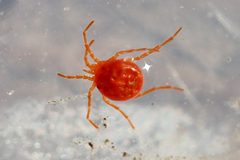
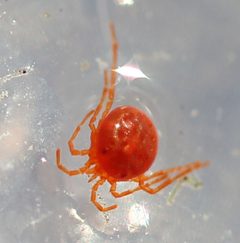
1Hydryphantidae is a of water mites (Hydrachnidia) in the order Trombidiformes, containing over 30 and approximately 130 described . Members are primarily aquatic, inhabiting freshwater environments including streams, springs, and lakes. The family exhibits diverse strategies, with larvae of some species acting as on insects such as mosquitoes and springtails, while other species show different associations. and deutonymphs are generally free-living with crawling locomotion, lacking swimming setae on their legs.
Pronunciation
How to pronounce Hydryphantidae: /haɪˈdraɪˌfæntɪˌdiː/
These audio files are automatically generated. While they are not always 100% accurate, they are a good starting point.
Images
Habitat
Freshwater aquatic environments including small streams, springs (particularly helocrenes with groundwater seepage), and lakes. Some occupy shaded, sloping banks of headwater streams with partially saturated soils and trickling groundwater.
Distribution
Widespread across the Northern Hemisphere with records from Europe, North America (including Oregon, Vermont, and Québec), and Scandinavia (Denmark, Norway, Sweden). Individual show more restricted ranges; for example, Panisellus thienemanni is confined to Europe with scattered distribution, while Cyclothyas siskiyouensis is known only from Oregon.
Host Associations
- Culicidae (Diptera) - larval on mosquitoes including Aedes, Anopheles, Culex, and Mansonia
- Tomoceridae (Collembola) - larval on springtails; two documented as for Panisellus thienemanni
- Isotomuridae (Collembola) - Isotomurus fucicola documented as for Panisellus thienemanni in the Netherlands
Life Cycle
Complex typical of Parasitengona with parasitic larval stage and free-living predatory deutonymph and stages. Larvae of some attach to arthropods; infected hosts have been observed from April through June in at least one species. The complete life cycle remains incompletely understood for many species.
Behavior
and deutonymphs exhibit crawling locomotion with legs lacking swimming setae, distinguishing them from more actively swimming water mite . Larvae are ectoparasitic, attaching to specific body regions of such as the soft on the dorsomedial side of the reduced prothorax of springtails. Some represent exceptions to the general pattern of water mite via flying insects.
Ecological Role
Larvae function as on aquatic and semi-aquatic insects and springtails, potentially affecting . and deutonymphs likely serve as in freshwater . Their specific ecological roles remain poorly documented for most .
Sources and further reading
- BugGuide
- Wikipedia
- GBIF taxonomy match
- iNaturalist taxon
- NCBI Taxonomy
- Catalogue of Life
- Contribution to the life history and morphology of the water mite Panisellus thienemanni (Acari, Hydrachnidia: Hydryphantidae)
- Inventaire préliminaire d'acariens (Acari : Hydryphantidae et Arrenuridae) ectoparasites de moustiques (Diptera : Culicidae) du lac Boivin, Granby, Québec
- DESCRIPTION OF ADULTS OF A NEW SPECIES OF CYCLOTHYAS (ACARI: PARASITENGONA: HYDRYPHANTIDAE) FROM WESTERN NORTH AMERICA, WITH COMMENTS ON PHYLOGENY AND DISTRIBUTION OF MITES OF THE GENUS