
Pentatomidae
Leach, 1815
stink bugs, shield bugs
Subfamily Guides
5- Asopinae(Predatory Stink Bugs)
- Discocephalinae(shield bugs)
- Edessinae
- Pentatominae(shield bugs)
- Podopinae(Turtle Bugs)
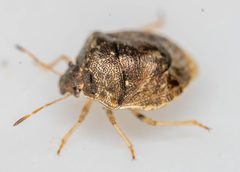
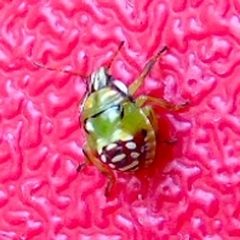
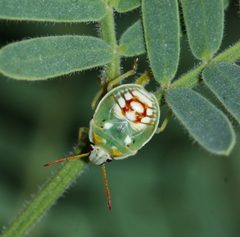
is the largest in the superfamily Pentatomoidea, comprising approximately 900 and over 4,700 . Members are commonly known as stink bugs or shield bugs, distinguished by their ability to release defensive secretions when disturbed. The family exhibits diverse feeding strategies: most species are phytophagous and include major agricultural pests, while members of the Asopinae are predatory. The family name derives from Greek 'pente' (five) and 'tomos' (section), referring to the five-segmented characteristic of all pentatomids.
Pronunciation
How to pronounce Pentatomidae: /pɛn.təˈtoʊ.mɪˌdiː/
These audio files are automatically generated. While they are not always 100% accurate, they are a good starting point.
Identification
Distinguished from related in Pentatomoidea by the combination of five-segmented , three tarsal segments, and exposed membranous portions of the (scutellum does not completely cover abdomen, unlike Scutelleridae). The predatory Asopinae can be recognized by enlarged forelegs in some , though this trait is not universal. Within , species identification often requires examination of thoracic spines, antenna coloration, and abdominal markings; for example, southern green stink bug (Nezara viridula) has a short rounded ventral spine between hind leg attachments and reddish antennal bands, while green stink bug (Chinavia hilaris) has a longer pointed spine and black antennal bands.
Images
Habitat
Agricultural crops, orchards, forests, and natural vegetation. Many overwinter in sheltered locations including beneath tree bark, in rocky crevices, or within human structures. Suitable for expansion have been identified in temperate regions such as the Midwest United States. Specific microhabitat requirements vary by species and season.
Distribution
Worldwide distribution. Native to all continents except Antarctica; numerous have become outside native ranges. The brown marmorated stink bug (Halyomorpha halys), native to East Asia, has established in North America (47 U.S. states and 4 Canadian provinces as of recent records), Europe, and other regions. The southern green stink bug (Nezara viridula) occurs globally in tropical and subtropical zones. South American soybean regions (Argentina, Brazil) support significant pentatomid diversity and pest pressure.
Seasonality
Activity patterns vary by climate. In temperate regions, seek in autumn (September–October), enter reproductive during winter, and emerge in spring (March–April) when temperatures reach approximately 15–20°C. Multiple may occur annually in warmer climates; in South American soybean systems, sequential generations develop first on legume weeds then on flowering soybeans. Prolonged warm periods can extend activity seasons and trigger premature from overwintering sites.
Diet
Most are phytophagous, feeding on plant fluids from developing seeds, fruits, and vegetative tissues using . Documented include soybean, cotton, corn, sorghum, alfalfa, peppers, tomatoes, various fruits, and ornamental plants. Some species have been observed feeding on houseplants including orchids and ponytail palms when confined indoors. Members of the Asopinae are predatory, feeding on caterpillars and other soft-bodied insects.
Host Associations
- Glycine max - pestsoybean; major economic for multiple
- Gossypium hirsutum - pestcotton
- Zea mays - pestcorn
- Sorghum bicolor - pestsorghum
- Phaseolus vulgaris - pestcommon bean; laboratory for Acrosternum bellum
- Prosopis - mesquite; weed for Chlorochroa ligata
- Leguminosae (weeds) - early-season supporting first before soybean
Life Cycle
Development from to typically requires 4–6 weeks under favorable conditions, though this varies by and temperature. Eggs are barrel-shaped and deposited in masses on plants. Nymphs pass through five instars before reaching adulthood; wing pads become visible in later instars. Mean development time for Acrosternum bellum was 38.5 days at 24.6°C. Cumulative nymphal mortality can be substantial (74.5% in laboratory studies of A. bellum), with highest mortality often occurring in the second instar. Adults may live 70+ days; mean longevity of 73.3 days recorded for A. bellum.
Behavior
Defensive secretion: When threatened, disturbed, or crushed, pentatomids discharge a pungent spray from . The chemical composition varies by , sex, and age, generally including aldehydes and alkanes; some species produce cyanide compounds with rancid almond odor. Seasonal movement: exhibit directed movement to sites in autumn and egress from these sites in spring. In agricultural landscapes, adults fly between plants and fields. form at overwintering sites and on preferred hosts. Vibratory communication occurs via substrate-borne signals, which has been exploited for trap development.
Ecological Role
As phytophages, pentatomids function as herbivores that reduce plant through seed and fruit damage, indirectly affecting seed and plant recruitment. As prey, they support diverse natural enemy including (Trissolcus spp., Telenomus podisi), predatory arthropods (Chinese mantis, wheel bug, spiders, ground beetles, katydids), and microorganisms ( bassiana, Nosema maddoxi). Predatory Asopinae contribute to of lepidopteran and other pest . disrupt native and compete with herbivores.
Human Relevance
Major agricultural pests causing yield and quality reductions in soybean, cotton, corn, and specialty crops. Feeding damage includes seed abortion, flat pod , delayed maturity, and reduced germination. for management: 36 and large nymphs per 100 sweeps for most , 16 per 100 sweeps for redbanded stink bug (Piezodorus guildinii) due to higher per-capita damage. Control relies on , though resistance has been documented; alternative approaches include using and microbial agents. Nuisance pest status: Brown marmorated stink bug invades homes in large numbers for , causing significant household annoyance without reproducing indoors. Cultural use: Some species (e.g., Edessa mexicana) are consumed as food in Mexico (jumil, chinche de monte), prepared in sauces or as taco filling.
Similar Taxa
- ScutelleridaeAlso called shield bugs; distinguished by greatly enlarged scutellum that completely covers and wings, giving a rounded 'shield-backed' appearance
- AcanthosomatidaeSometimes called shield bugs in British English; morphologically similar but phylogenetically distinct; identification requires examination of genitalia and other subtle characters
- CydnidaeBurrowing bugs with shield-like shape but adaptations including spiny forelegs for digging; often associated with soil and roots rather than above-ground plant parts
- CoreidaeLeaf-footed bugs with elongated body form and frequently expanded hind tibiae; lack the broad shield shape and five-segmented formula of
More Details
Invasive species management
Halyomorpha halys (brown marmorated stink bug) represents one of the most significant recent insect invasions in North America. Spread facilitated by human transport; established across 47 U.S. states. Climate change may expand suitable ranges and alter survival. programs have introduced or evaluated Trissolcus japonicus and T. mitsukurii from native Asian ranges.
Gut symbionts
Pentatomids harbor obligate bacterial transmitted vertically via surface smears. These microbiome associates are essential for nymphal development and survival. High temperatures may disrupt symbiont transmission or function, potentially explaining declines following extreme heat events.
Taxonomic complexity
The contains multiple with divergent ecologies: Pentatominae (largest, mostly phytophagous), Asopinae (predatory), Podopinae (often associated with grasses), and others. The subfamily Aphylinae, restricted to Australia, is sometimes treated as a separate family.
Sources and further reading
- BugGuide
- Wikipedia
- GBIF taxonomy match
- iNaturalist taxon
- NCBI Taxonomy
- Catalogue of Life
- Soybean Insects: Late-Season Pests (R1 to R7) - AgriLife Extension Entomology
- Pentatomidae | Beetles In The Bush | Page 2
- With a stinky exodus underway, not all stink bugs survived a “severe” winter in some parts of our country: Brown marmorated stink bug, Halyomorpha halys — Bug of the Week
- Stink bugs on the move: Brown Marmorated Stink Bug, Halyomorpha halys — Bug of the Week
- ID Challenge #7 | Beetles In The Bush
- Reveille for BMSB: Wake-up call for brown marmorated stink bug (BMSB), Halyomorpha halys — Bug of the Week
- Redbanded Stink Bug, Piezodorus guildinii, (Hemiptera: Heteroptera: Pentatomidae), Biology, Identification, and Pest History
- Biología de Acrosternum bellum Rolston, 1983 (Hemiptera, Pentatomidae) Biology of Acrosternum bellum Rolston, 1983 (Hemiptera, Pentatomidae)
- Representatives of the genus 'Trissolcus' (Hymenoptera: Scelionidae) on the territory of Serbia, natural enemies of pests of Pentatomidae family (Hemiptera: Pentatomidae)
- Spatial and Temporal Distribution of the Brown Marmorated Stink Bug (Hemiptera: Pentatomidae)
- Potential of Beauveria bassiana in the control of Euschistus crenator (Hemiptera: Pentatomidae) and selectivity to the parasitoid Telenomus podisi (Hymenoptera: Scelionidae).