
Pyrgodesmidae
Silvestri, 1896
Genus Guides
2Pyrgodesmidae is one of the largest of millipedes, comprising over 170 and nearly 400 . Members are small, flat-backed polydesmids distributed throughout tropical and subtropical regions worldwide. The family exhibits notable ecological diversity, including obligate myrmecophily in some genera and parthenogenetic in others. Several species have been introduced to non-native regions through human activity.
Pronunciation
How to pronounce Pyrgodesmidae: /pɪrˌɡoʊˈdɛzmɪˌdiː/
These audio files are automatically generated. While they are not always 100% accurate, they are a good starting point.
Identification
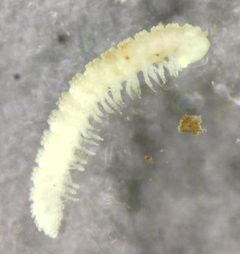
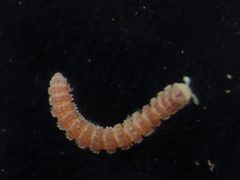
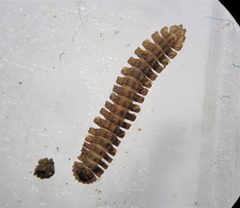
Distinguished from other polydesmid by the combination of: small body size (<20 mm); fan-shaped collum completely or nearly completely covering the from above with radiating ornamentation; tergites with downward-sloping lateral margins bearing rows of lobes or ; ozopores on short columns with atypical segmental distribution; and absence of volvation. Some exhibit reduced segment number (19 segments in of Poratia versus typical 20 in Polydesmida).
Images
Appearance
Small millipedes ranging from 3–16 mm in length, predominantly 6–10 mm. Body uniformly grayish or brownish. Collum large, fan-shaped, covering most or all of the from above, with surface ornamented by distinct radiating lines or small lobes. Tergites slope downward with conspicuous lobes or usually arranged in rows. Ozopores often open on short columns and deviate from typical polydesmidan segmental distribution. Paranota frequently bear small lobes on anterior or margins. Incapable of volvation (rolling into a ball).
Habitat
Primarily tropical and subtropical forests, occupying leaf litter, soil, and decaying wood. Some inhabit periodically inundated floodplain forests, including riparian zones of major river systems. Others are strictly terrestrial in dry forest . Several are obligate inhabitants of colonies (myrmecophiles), including Myrmecodesmus, Calymmodesmus, Cynedesmus, and Rettenmeyeria. Some species occur in caves.
Distribution
Pantropical and subtropical distribution: tropical Africa, southern Europe, North Africa, central China, Taiwan, Japan, southern United States (Texas) through Central and South America to Brazil, West Indies, India, East Indies, New Caledonia, Hawaii, and Pacific islands. Recently confirmed from Australia (Queensland), representing first native records for that continent.
Host Associations
- Ants - myrmecophilyObligate myrmecophiles in Myrmecodesmus, Calymmodesmus, Cynedesmus, and Rettenmeyeria; some found exclusively in army ant colonies
- Termites - associationMyrmecodesmus hastatus recorded from nests
Life Cycle
Development includes six stages prior to adulthood. In Poratia salvator, total development averages 66 days with maturity at approximately 75 days. Some complete within one year. Parthenogenetic produce 7–10 per nest with after approximately 10 days. Survival to adulthood low (18% observed in laboratory). time varies by population: shorter in floodplain populations, longer in terrestrial populations.
Behavior
Low vagility with limited capability. Some exhibit high colonizing ability facilitated by parthenogenetic . Thelytokous females in parthenogenetic may have greater desiccation resistance and lower energy expenditure than sexual populations due to absence of mate-searching and copulation. One species (Cryptocorypha ornata) apparently dispersed widely across Indian and Pacific Ocean islands through anthropogenic or avian transport.
Ecological Role
Leaf litter decomposers in forest . Contribution to nutrient cycling in tropical and subtropical forests, including periodically inundated floodplain systems.
Human Relevance
Some parthenogenetic (notably Poratia species) introduced to European hothouses. Potential for accidental transport through human activity, as evidenced by widespread distribution of some species on oceanic islands. Museum collections have proven valuable for documenting overlooked diversity, as demonstrated by discovery of Australian fauna in archived specimens.
Similar Taxa
- Other Polydesmida familiesPyrgodesmidae distinguished by small size, fan-shaped collum with radiating ornamentation, atypical ozopore distribution on short columns, and absence of volvation
- Poratia species with 19 segments with 19 segments (versus typical 20 in Polydesmida) may be confused with other short-bodied polydesmids; identification requires examination of structure
More Details
Taxonomic diversity
contains approximately 120 , representing substantial generic-level diversity relative to . Taxonomic revision has consolidated many previously recognized genera, particularly in Mexican fauna.
Parthenogenesis
Poratia includes capable of parthenogenetic , with Poratia salvator exhibiting extreme female-biased sex ratios (1 male:139.8 females). in this genus has been linked to presence of flavobacteria.
Segment number variation
Poratia includes four with only 19 segments as (counting collum, , and intervening rings), one fewer than typical for Polydesmida.
Sources and further reading
- BugGuide
- Wikipedia
- GBIF taxonomy match
- iNaturalist taxon
- NCBI Taxonomy
- Catalogue of Life
- Uncategorized | Blog - Part 46
- Millipede family added to Australian fauna | Blog
- Life cycle of Poratia salvator (Diplopoda: Polydesmida: Pyrgodesmidae)
- Fertility tables of two populations of the parthenogenetic species Poratia salvator (Diplopoda, Polydesmida, Pyrgodesmidae)
- A new species of the millipede genus Cryptocorypha Attems, 1907, from northern Thailand (Polydesmida, Pyrgodesmidae)
- A new name for Myrmecodesmus potosinus (Shear) 1973, a homonym of Myrmecodesmus potosinus (Chamberlin) 1943 (Diplopoda, Polydesmida, Pyrgodesmidae)
- Filling a gap in the distribution of Taulidesmella tabatinga (Polydesmida, Pyrgodesmidae): a new record from the upper Amazon River, Brazil
- Morphological adaptations of the semiaquatic millipedeAporodesminus wallaceiSilvestri 1904 with notes on the taxonomy, distribution, habitats and ecology of this and a related species (Pyrgodesmidae Polydesmida Diplopoda)
- Detailed iconography of the widespread Neotropical millipede, Myrmecodesmus hastatus (Schubart, 1945), and the first record of the species from the Caribbean area (Diplopoda, Polydesmida, Pyrgodesmidae)