
Arthrorhabdus
Pocock, 1891
Species Guides
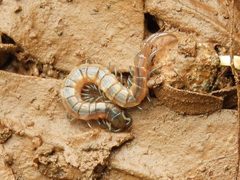
1Arthrorhabdus is a of scolopendrid centipedes established by Reginald Innes Pocock in 1891. The genus currently contains four recognized following a 2010 taxonomic reappraisal that removed two former members. Species are distributed disjunctly across the southwestern United States and Mexico, Australia, and South Africa. The genus may be polyphyletic based on its scattered distribution and morphological similarities to other genera.
Pronunciation
How to pronounce Arthrorhabdus: //ɑrˌθɹoʊˈræbdəs//
These audio files are automatically generated. While they are not always 100% accurate, they are a good starting point.
Identification
Arthrorhabdus possess 18–26 antennomeres. The does not overlap the first tergite, distinguishing the from Cormocephalus and others. , , and mouthpart resembles Cormocephalus, but leg morphology differs. The genus can be separated from Scolopendra by mouthpart and spiracle shape. Differentiation from Asanada requires examination of multiple character systems.
Images
Distribution
occur in three disjunct regions: southwestern United States and Mexico (A. pygmaeus, with possible occurrence in Belize), Australia (A. paucispinus and A. mjöbergi), and South Africa (A. formosus).
Similar Taxa
- CormocephalusShares , , and mouthpart ; distinguished by leg morphology and not overlapping first tergite
- ScolopendraSimilar overall form; distinguished by mouthpart and shape
- AsanadaResembles in general scolopendrid ; requires detailed character examination for separation
More Details
Taxonomic instability
The has undergone substantial revision. A 2010 reappraisal by John G. E. Lewis removed A. jonesii and A. somalus, with the latter transferred to Scolopendra somala. A. spinifer was moved to Rhoda in 2004. The remaining four may not form a .
Etymology
The name derives from Greek ἄρθρον (arthron, joint) and ῥάβδος (rhabdos, staff or rod).