
Phryganeidae
Leach, 1815
Giant Casemaker Caddisflies
Genus Guides
5- Agrypnia
- Banksiola(Traveller Sedges)
- Oligostomis(giant casemakers)
- Phryganea(giant caddisfly)
- Ptilostomis(Giant Rusty Sedges)
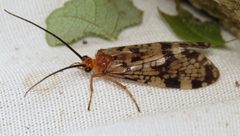
is a of large comprising approximately 16 and at least 80 described . are among the largest caddisflies, with wingspans reaching 40 mm or more. Larvae are aquatic case-makers, constructing distinctive cylindrical cases from plant fragments arranged in ring-like patterns. The family occurs across the Holarctic region, with species inhabiting diverse freshwater from cool mountain streams to acidic bog pools.


Pronunciation
How to pronounce Phryganeidae: /ˌfrɪɡəˈniːədiː/
These audio files are automatically generated. While they are not always 100% accurate, they are a good starting point.
Identification
distinguished from other caddisfly by large size, broad wings, and maxillary palpi with 4–5 segments (most phryganeids have 4 segments; Yphriinae has 5). Larvae identified by ring-like case construction (plant fragments in discrete circular bands rather than continuous spiral), anchor-like frontoclypeal marking, and contiguous mesonotal . Differs from Limnephilidae by case structure and mesonotal sclerite arrangement. Beothukus and related lack decticous pupal and do not construct silken sieve at .
Images
Habitat
Larvae occur in diverse freshwater including lakes, ponds, slow-moving streams, temporary woodland pools, and sphagnum bog pools. Some inhabit cool mountain streams. are typically found near larval habitats, often in riparian vegetation.
Distribution
Holarctic distribution. North America: widespread across northern and montane regions, from Alaska and Canada through the western United States (California, Oregon). Europe: including Scandinavia, Poland, Iceland, and Russia. Asia: Thailand and other regions.
Seasonality
Varies by and latitude. Banksiola crotchi: laid in fall, July–September. Beothukus complicatus: . Trichostegia minor: associated with temporary woodland pools. Many northern species have extended larval development with adult in summer.
Diet
Larvae: feeding habits vary ontogenetically and among . Banksiola crotchi instars II–IV feed primarily on filamentous ; final instar becomes , consuming insects and crustaceans. Beothukus complicatus larvae feed on algae, insects, and crustaceans.
Life Cycle
Holometabolous with aquatic larval and pupal stages. laid on submerged vegetation. Larval development includes 5 instars; growth rapid in fall and spring for some . occurs within larval case or modified pupal case. Some species ; others may have extended development. Yphria californica constructs pupal cases from materials different from larval cases.
Behavior
Larvae are case-makers, constructing portable cylindrical shelters from plant fragments fastened with silk. Case construction distinctive: plant pieces arranged in 5 or more successive ring-like patterns rather than continuous spiral. Some exhibit ontogenetic dietary shifts, becoming in final instars. are weak fliers, typically remaining near water.
Ecological Role
Larvae function as herbivores, , and depending on and instar. Link aquatic to terrestrial through . Some species tolerant of acidic conditions (pH 4.2–4.9), contributing to biodiversity in oligotrophic bog . Cases provide substrate for epiphytic growth and microhabitat structure.
Human Relevance
Occasional indicators of water quality in biomonitoring programs. Some of conservation concern (e.g., Hagenella clathrata in Poland, listed in national Red Book). occasionally attracted to lights. No significant economic importance.
Similar Taxa
- LimnephilidaeBoth are large case-making caddisfly with overlapping distributions. distinguished by ring-like case construction (vs. spiral in Limnephilidae), contiguous mesonotal in larvae, and maxillary palpus segmentation.
- GoeridaeSimilar large body size and case-making larvae. cases constructed from plant fragments in rings; Goeridae typically use sand grains.
- BrachycentridaeBoth construct cases from plant material. cases are cylindrical with distinct ring construction and larvae lack the curved anal hooks characteristic of Brachycentridae.
Sources and further reading
- BugGuide
- Wikipedia
- GBIF taxonomy match
- iNaturalist taxon
- NCBI Taxonomy
- Catalogue of Life
- New data on the distribution and habitat preferences of Hagenella clathrata (Kolenati, 1848) (Trichoptera: Phryganeidae) in Poland - the species from the Polish Red Book of Animals / Nowe dane o rozmieszczeniu i wymaganiach siedliskowych Hagenella clathrata (Kolenati, 1848) (Trichoptera: Phryganeidae) w Polsce - gatunku z Polskiej czerwonej księgi zwierząt
- A PRELIMINARY SYSTEMATIC STUDY OF THE NORTH AMERICAN LARVAE OF THE CADDISFLY FAMILY PHRYGANEIDAE (TRICHOPTERA)
- The larva of Eubasilissa maclachlani White 1862 (Trichoptera: Phryganeidae) from Thailand, with notes on its biology
- A NEW SUBFAMILY OF PHRYGANEID CADDISFLIES FROM WESTERN NORTH AMERICA (TRICHOPTERA: PHRYGANEIDAE)
- Identification of Icelandic caddis larvae, with descriptions of Limnephilus fenestratus (Zett.) and L. picturatus McL. (Trichoptera: Limnephilidae, Phryganeidae)
- An ecological study of Banksiola crotchi Banks (Trichoptera, Phryganeidae) in Marion Lake, British Columbia
- Life cycle and growth ofTrichostegia minor (Curtis) in temporary woodland pools (Trichoptera: Phryganeidae)
- Systematics and biology for a new Nearctic genus in the caddisfly family Phryganeidae (Trichoptera)