
Lepidostomatidae
Ulmer, 1903
Bizarre Caddisflies
Genus Guides
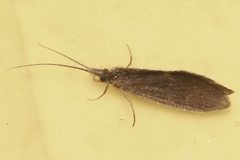
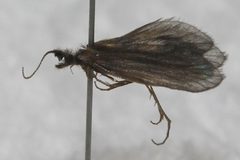
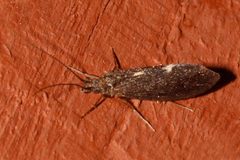
1is a of caddisflies (Trichoptera) established by Georg Ulmer in 1903. Larvae construct distinctive cases, often square or rectangular in cross-section, using materials such as leaf pieces, sand grains, or rarely living snails. The family has a predominantly Northern Hemisphere distribution with some ranging south to Panama and New Guinea. Larvae are aquatic and primarily associated with streams and rivers.
Pronunciation
How to pronounce Lepidostomatidae: //lɛpɪˌdɒstəˈmætɪdiː//
These audio files are automatically generated. While they are not always 100% accurate, they are a good starting point.
Identification
Larvae recognized by their characteristic case architecture: typically square or four-sided rectangular cross-sections constructed from leaf pieces, sand grains, or mineral particles. Some use cylindrical sand-grain cases in early instars, transitioning to four-sided leaf cases in final instars. distinguished by -level genitalic and wing venation characters; specific identification requires examination of male genitalia, which shows geographical variation in some species (more protrusive and complex in southwestern Japan of Goerodes naraensis).
Images
Habitat
Aquatic larvae inhabit streams, rivers, and lake beds, typically in riffle-pool sections or debris accumulations. Some occupy specific microhabitats: within sediments and debris (Lepidostoma cascadense) or on debris surfaces (Lepidostoma unicolor). Larvae of Lepidostoma abruptum found in small debris pools with leaf litter and small branches in evergreen forests.
Distribution
Widely dispersed globally with concentration in Northern Hemisphere. Documented from: North America (Oregon, Vermont), Europe (Denmark, Norway, Sweden), Asia (Japan, Thailand, Ukraine), and southward to Panama and New Guinea.
Seasonality
Variable by and latitude. Lepidostoma quercina shows maximum larval growth corresponding to autumn leaf fall; L. cascadense pupates May-June after slow winter growth; L. unicolor grows rapidly June-July. Goerodes naraensis in Sapporo with larvae appearing midsummer, as fifth instar, emerging late spring. Some tropical species (Lepidostoma abruptum) non-seasonal.
Diet
Larvae feed on allochthonous plant detritus, primarily conditioned deciduous leaves (alder leaves preferred by Lepidostoma quercina) and conifer needles (processed by L. cascadense and L. unicolor). Consumption rates increase with temperature, food quantity, and conditioning time of leaves.
Life Cycle
Development includes , larva (typically 5 instars), pupa, and . Larval capsule widths measurable to determine instars. Some with as final instar larvae; others show multivoltine patterns (Goerodes nukabiraensis: three in two years). occurs in constructed cases.
Behavior
Larvae exhibit seasonal longitudinal distribution shifts in some ; Goerodes japonicus group shows sequential downstream summer distribution with overlapping zones. Case construction changes with instar in some species: cylindrical sand-grain cases early, four-sided leaf cases in final instar. Rare behavioral record: Crunoecia irrorata has been observed incorporating living snails (Terrestribythinella) into larval cases.
Ecological Role
of coarse particulate organic matter in stream . Processing of leaves and conifer needles contributes to fine particulate organic matter availability for collector organisms. Fecal production by Lepidostoma quercina estimated sufficient to support substantial portion of simuliid production in Oregon streams. Generally minor component of secondary production relative to other but significant in organic matter processing .
Sources and further reading
- BugGuide
- Wikipedia
- GBIF taxonomy match
- iNaturalist taxon
- NCBI Taxonomy
- Catalogue of Life
- Description, Geographical Variation and Ecology of Goerodes naraensis (Tani) (Trichoptera, Lepidostomatidae)
- Longitudinal distribution and annual life cycle of the japonicus group of Goerodes(Trichoptera,Lepidostomatidae).
- Population Dynamics, Bioenergetics, and Role of Lepidostoma Quercina Ross (Trichoptera: Lepidostomatidae) in an Oregon Woodland Stream
- Larval morphology, life cycle and nutritional values of Lepidostoma abruptum Banks 1931 (Trichoptera: Lepidostomatidae) from Lower-Hill Evergreen Forests of Southern Thailand
- ENDEMIC SPRING SNAILS TERRESTRIBYTHINELLA (MOLLUSCA) AS UNUSUAL MATERIAL FOR LARVAL CASE OF CRUNOECIA IRRORATA (TRICHOPTERA: LEPIDOSTOMATIDAE) IN TRANSCARPATHIAN UKRAINE
- Populations Dynamics and Role of Two Species of Lepidostoma (Trichoptera: Lepidostomatidae) In an Oregon Coniferous Forest Stream
- Phylogenetic Analysis of the Family Lepidostomatidae (Trichoptera: Integripalpia) Using Whole Mitochondrial Genomes.