
Hydropsyche oslari
Banks, 1905
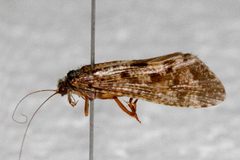
Hydropsyche oslari is a of caddisfly (order Trichoptera) in the Hydropsychidae, first described by Banks in 1905. The species has been reclassified under the Ceratopsyche by some authorities, though it is still widely referenced as Hydropsyche oslari. It belongs to a group of net-spinning caddisflies that construct fixed retreats and capture nets in flowing water environments. Like other hydropsychids, the larvae are aquatic filter-feeders that play important roles in stream .
Pronunciation
How to pronounce Hydropsyche oslari: /haɪˈdrɒpsɪki ˈɒsləraɪ/
These audio files are automatically generated. While they are not always 100% accurate, they are a good starting point.
Images
Habitat
Flowing water environments including streams and rivers. As a member of Hydropsychidae, larvae construct fixed retreats with capture nets in current-exposed locations on submerged substrates.
Distribution
North America. Records indicate presence across the continent, though specific range details beyond continental-level occurrence are not well documented in available sources.
Ecological Role
As a net-spinning caddisfly, larvae function as aquatic filter-feeders that process organic matter and serve as prey for fish and other aquatic . The fixed retreats and capture nets modify local hydrodynamics and provide microhabitat for other small .
More Details
Taxonomic Status
Hydropsyche oslari is currently treated as a synonym of Ceratopsyche oslari in the Catalogue of Life and GBIF, reflecting ongoing taxonomic revision within the Hydropsychidae. The Ceratopsyche was established to accommodate previously placed in Hydropsyche that share derived morphological characters, though many sources continue to use the older combination.
Data Limitations
Available sources provide minimal -specific information. The iNaturalist page shows only 3 observations, and no detailed biological studies or species accounts were found in the provided context. Most ecological generalizations about this species would need to be inferred from -level characteristics, which is not done here per instructions.