
Hectopsylla
Von Frauenfeld, 1860
Species Guides
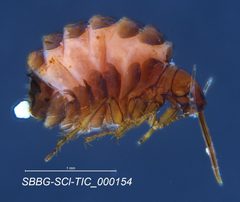
1- Hectopsylla pulex(chigger flea)
A of stick-tight fleas in the , comprising thirteen that parasitize non- mammals, birds, and bats. The genus was established by Von Frauenfeld in 1860, with H. psittaci as the type species. Several species were described by Karl Jordan between 1906 and 1942. The genus exhibits specialized attachment , with females of some species becoming permanently embedded in host skin.
Pronunciation
How to pronounce Hectopsylla: /hɛk.toʊˈpsɪl.ə/
These audio files are automatically generated. While they are not always 100% accurate, they are a good starting point.
Images
Distribution
occur across the Neotropical region, with records from North America (Arizona, California, Texas), Central America (Panama), and South America (Argentina, Bolivia, Brazil, Chile, Colombia). Specific distribution varies by species: H. pulex has been documented from Arizona to Brazil and Colombia; H. psittaci ranges from northern Chile to California; H. knighti represents the only species described outside South America (Michoacán, Mexico).
Diet
Blood-feeding ; females of some feed to repletion on blood.
Host Associations
- Leptonycteris yerbabuenae - Lesser long-nosed bat; for H. pulex in Arizona
- Molossus molossus - Pallas's mastiff bat; for H. pulex in Colombia
- Molossus rufus - for H. pulex
- Tadarida brasiliensis - Brazilian free-tailed bat; for H. pulex
- Eptesicus furinalis - Argentine brown bat; first record for H. pulex in Colombia
- Cyanoliseus patagonus patagonus - Burrowing parrot; for H. narium in Patagonia
- Petrochelidon pyrrhonota - American cliff swallow; for H. psittaci in California
- Hydrobates markhami - Markham's storm petrel; for H. psittaci in northern Chile
- Conepatus humboldtii - Humboldt's hog-nosed skunk; for H. broscus in Argentina
- Conepatus arequipae - Hog-nosed skunk; for H. coniger in Bolivia
- Chelemys macronyx - Andean long-clawed mouse; for H. pascuali in Argentina
- Eligmodontia typus - for H. gracilis in Argentina
- Akodon caenosus - for H. gracilis
Life Cycle
, larva, pupa, . In H. pulex, eggs are expelled onto the and fall to the substrate; only eggs deposited in bat guano near host colonies complete development. Newly emerged acquire hosts near guano deposits. Females attach, feed to repletion, become gravid, autosever their legs, and die in situ.
Behavior
Females of some exhibit permanent attachment to via serrated , remaining after initial attachment. In H. narium, freshly emerged can jump up to 25 cm horizontally and crawl vigorously before attachment. Once anchored, females become sessile and remain attached until death. Males of H. narium were observed in host nostrils but not feeding on nestlings; mating occurs in nasal cavities. Males of H. pulex have not been found attached to hosts, only collected from bat guano, suggesting copulation occurs before females acquire hosts. Females of H. pulex autosever legs at apices of or after becoming .
Ecological Role
of mammals and birds; contribute to nutrient cycling in roost environments through and debris falling into guano deposits. Large females may potentially interfere with bat echolocation due to size relative to the tragus, though this has not been experimentally demonstrated.
Sources and further reading
- BugGuide
- Wikipedia
- GBIF taxonomy match
- iNaturalist taxon
- NCBI Taxonomy
- Catalogue of Life
- New distribution and host records for Hectopsylla pulex Haller (Siphonaptera, Tungidae) with notes on biology and morphology
- The chiggerflea Hectopsylla pulex (Siphonaptera: Tungidae): infestation on Molossus molossus (Chiroptera: Molossidae) in the Central Andes of Colombia
- Hectopsylla pulex (Haller, 1880) (Siphonaptera: Tungidae) infestation on Eptesicus furinalis (Chiroptera: Vespertilionidae) in the Central Andes of Colombia
- Figure 1 from: Hastriter M, Meyer M, Sherwin R, Dittmar K (2014) New distribution and host records for Hectopsylla pulex Haller (Siphonaptera, Tungidae) with notes on biology and morphology. ZooKeys 389: 1-7. https://doi.org/10.3897/zookeys.389.7042
- Figures 2–3 from: Hastriter M, Meyer M, Sherwin R, Dittmar K (2014) New distribution and host records for Hectopsylla pulex Haller (Siphonaptera, Tungidae) with notes on biology and morphology. ZooKeys 389: 1-7. https://doi.org/10.3897/zookeys.389.7042
- Figures 4–5 from: Hastriter M, Meyer M, Sherwin R, Dittmar K (2014) New distribution and host records for Hectopsylla pulex Haller (Siphonaptera, Tungidae) with notes on biology and morphology. ZooKeys 389: 1-7. https://doi.org/10.3897/zookeys.389.7042