
Polyplacidae
Fahrenholz, 1912
spiny rat lice
Genus Guides
1- Polyplax(Mouse Lice)
is a of sucking lice () comprising approximately 193 as of 2010. Members are obligate permanent of small mammals, with documented including rodents (spiny rats, squirrels, pouched rats), lagomorphs (rabbits, hares), and primates (bushbabies, lemurs). The family exhibits distribution. Molecular evidence suggests the family is and requires taxonomic revision.
Pronunciation
How to pronounce Polyplacidae: /ˌpɒlɪˈplæsɪdiː/
These audio files are automatically generated. While they are not always 100% accurate, they are a good starting point.
Identification
Distinguished from other by combination of: 5-segmented ; small, slender, clawed forelegs; and middle and hindlegs that are subequal or with hindlegs larger. present. Members parasitize diverse small mammal rather than ungulates (Linognathidae) or primates (Pediculidae).
Images
Appearance
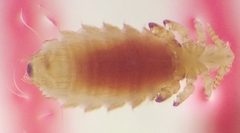
Small to medium-sized with dorso-ventrally flattened, wingless bodies. Sexually dimorphic. Five-segmented . Small, slender, clawed forelegs; middle and hindlegs subequal in size or with hindlegs enlarged. adapted for blood-feeding.
Habitat
Obligate ectoparasitic on pelage and skin surface of small mammals. No free-living stage. Seasonal track host , including hibernation cycles in temperate regions.
Distribution
distribution across Europe, Africa, Asia-Temperate, Asia-Tropical, and Australasia. Introduced to Australia with European rodents (Rattus norvegicus, R. rattus) beginning 1606-1788.
Seasonality
strongly correlated with cycles. In temperate regions, peaks in spring (April) and early summer (mid-June), with intensity peaking in June. predominant on hosts emerging from hibernation; nymphs predominant during host active season.
Diet
Obligate blood-feeders using . Heavy can cause hypersensitivity, dermatitis, and anemia.
Host Associations
- Rattus norvegicus - brown rat, introduced
- Rattus rattus - black rat, introduced
- Sylvilagus floridanus - eastern cottontail rabbit
- Lepus americanus - snowshoe hare
- Lepus townsendii - white-tailed jackrabbit
- Urocitellus richardsonii - Richardson's ground squirrel
- Rattus villosissimus - long-haired rat, Australian
- Rattus fuscipes - bush rat, Australian
- Rattus lutreolus - swamp rat, Australian
- Rattus sordidus - cane field rat, Australian
- Rattus tunneyi - pale field rat, Australian
- Rattus colletti - dusky rat, Australian
Life Cycle
Hemimetabolous with three developmental stages: , nymph, and . No free-living stage; entire completed on . Nymphs and adults present simultaneously, with seasonal shifts in stage structure: adults predominant on emerging hosts in spring, nymphs predominant during host active season. with separate sexes.
Behavior
Highly contagious (aggregated) distribution among , with most concentrated on few individuals. primarily by lice from parent to offspring hosts. Some exhibit remarkable host-switching ability: Polyplax spinulosa expanded from two introduced rodent hosts to at least six Australian rodent species within 200-400 years, contrasting with 16 million years to establish on eight native rat species in Eurasia.
Ecological Role
of small mammals with potential roles in through blood loss and dermatological impacts. Heavy may cause anemia and hypersensitivity reactions. Possible , though specific transmission documented primarily for individual rather than -wide.
Human Relevance
Polyplax spinulosa introduced to Australia with European , subsequently expanding to native rodents. Heavy in domestic and laboratory rodents may cause welfare concerns. Some documented as new records in museum collections, indicating historical spread via human-mediated rodent transport.
Similar Taxa
- HoplopleuridaeAnother of rodent-associated sucking lice; distinguished by leg and associations. Polyplax spinulosa co-occurs with Hoplopleura pacifica on introduced rodents in Australia, but only P. spinulosa successfully expanded to hosts.
- Linognathidae of sucking lice primarily parasitizing ungulates; distinguished by associations and morphological features including leg structure.
- Pediculidae containing human ; distinguished by primate specificity and morphological characteristics.
More Details
Taxonomic Status
Molecular data indicate is and requires revision to produce accurate -level description. Current description encompasses considerable morphological variation.
Mitochondrial Diversity
Polyplax spinulosa exhibits two distinct mitochondrial rrnL (European and Southeast Asian, 7.5% divergence), both introduced to Australia and both capable of expansion to rodents.
Host Expansion Success
Comparison of three introduced sucking lice in Australia (Polyplax spinulosa, P. serrata, Hoplopleura pacifica) indicates that both -specific and -specific factors contribute to successful host expansion. Only P. spinulosa achieved expansion to hosts.
Sources and further reading
- BugGuide
- Wikipedia
- GBIF taxonomy match
- iNaturalist taxon
- NCBI Taxonomy
- Catalogue of Life
- Ectoparasites of rabbits and hares in Manitoba, Canada, with observations on age-specific dispersal in Haemodipsus setoni (Phthiraptera: Anoplura: Polyplacidae)
- Rapid host expansion of an introduced parasite, the spiny rat louse Polyplax spinulosa (Psocodea: Phthiraptera: Polyplacidae), among endemic rodents in Australia
- Seasonal changes in the infestation parameters of the sucking louse, Linognathoides laeviusculus (Phthiraptera: Anoplura: Polyplacidae), infesting Richardson’s ground squirrel (Rodentia: Sciuridae) in Manitoba, Canada
- A New Species of Sucking Louse from the Long-Tailed Ground Squirrel, Urocitellus undulatus, from Mongolia, with a Key to Species, and a Review of Host Associations and Geographical Distributions of Members of the Genus Linognathoides (Psocodea: Anoplura: Polyplacidae)
- A new species of sucking louse Hoplopleura villosissima n. sp. (Psocodea: Phthiraptera: Hoplopleuridae) and a new host record of the spiny rat louse Polyplax spinulosa Burmeister, 1839 (Psocodea: Phthiraptera: Polyplacidae) from the long-haired rat Rattus villosissimus Waite (Rodentia: Muridae) in Australia