
Boyeria
McLachlan, 1896
spotted darners
Species Guides
2- Boyeria grafiana(Ocellated Darner)
- Boyeria vinosa(fawn darner)
Boyeria is a of in the Aeshnidae, commonly called spotted darners. The genus contains seven described distributed across temperate regions of North America and Eurasia. Species within this genus are associated with permanent stream and exhibit semivoltine or . The genus name commemorates French entomologist Étienne Laurent Joseph Hippolyte Boyer de Fonscolombe.
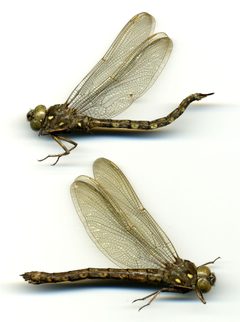
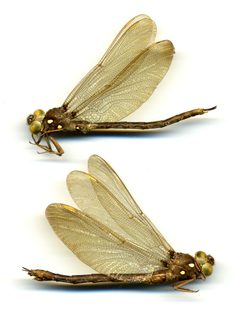
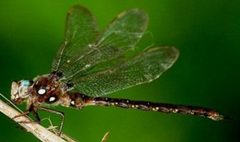
Pronunciation
How to pronounce Boyeria: /bɔɪˈɛ.ri.ə/
These audio files are automatically generated. While they are not always 100% accurate, they are a good starting point.
Images
Habitat
Associated with permanent streams. Larvae of studied occupy calcareous sinter mineral substrates with organic material including roots, leaves, and wood. Gallery vegetation present along stream margins. Altitudinal range for some species between 50–400 m.
Distribution
Temperate North America and Eurasia. Specific regional records include: Crete (Boyeria cretensis, ); Sierra Morena Mountains, southern Spain; western Spain; France; Switzerland; Tunisia; Italy; Republic of Korea (Boyeria karubei); Vermont, USA.
Seasonality
occurs in spring. Long flying season reported for some . Larval instar distribution during winter characteristic of 'summer species' pattern.
Life Cycle
Semivoltine (two-year development) or (one-year development) reported across ; some individuals require three years. Seven final larval stadia identified via wing length and width measurements in studied species.
Behavior
Larval microhabitat selection functions as antidrift strategy in dynamic winter hydrology. Potential avoidance against fish and crabs observed in some .
More Details
Etymology
The generic name Boyeria commemorates French entomologist Étienne Laurent Joseph Hippolyte Boyer de Fonscolombe.
Species diversity
Seven described : Boyeria cretensis (Cretan spectre), Boyeria grafiana (ocellated darner), Boyeria irene (western spectre), Boyeria jamjari, Boyeria karubei, Boyeria maclachlani, Boyeria sinensis, and Boyeria vinosa (fawn darner).
Taxonomic research
Molecular and morphological phylogenetic studies have confirmed boundaries, particularly validating Boyeria cretensis as distinct from Boyeria irene despite previous taxonomic uncertainty.
Sources and further reading
- BugGuide
- Wikipedia
- GBIF taxonomy match
- iNaturalist taxon
- NCBI Taxonomy
- Catalogue of Life
- Life History Characteristics and Prey Selection of LarvalBoyeria vinosa(Odonata: Aeshnidae)
- The life history of Boyeria irene (Fonscolombe, 1838) (Odonata: Aeshnidae) in the Sierra Morena Mountains (southern Spain)
- Larval habitats and life history of the Crete Island endemicBoyeria cretensis(Odonata: Aeshnidae)
- The life cycles of Boyeria irene and Onychogomphus uncatus (Odonata: Aeshnidae, Gomphidae) in western Spain: A biometric study
- Distribution status and habitat characteristics of <i>Boyeria karubei</i>, an endangered candidate species, in Republic of Korea
- Counting the spots: a molecular and morphological phylogeny of the spotted darner Boyeria ( O donata: A nisoptera: A eshnidae) with an emphasis on E uropean taxa