
Panorpodidae
Short-faced Scorpionflies
Genus Guides
1- Brachypanorpa(short-nosed scorpionfly)
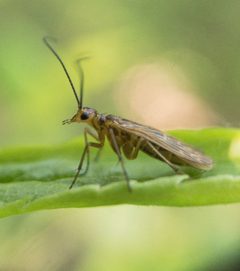
is a small of scorpionflies containing 13 extant in two . Brachypanorpa is restricted to the eastern and central United States, while Panorpodes occurs in East Asia (Japan, Korea) with one species in California. The family is distinguished from its sister group Panorpidae by notably short jaws, among the shortest of all mecopterans. Larvae possess smooth, glabrous without molar surfaces, indicating a diet distinct from the carrion-feeding larvae of related families.
Pronunciation
How to pronounce Panorpodidae: /pænˌɔːrˈpɒdɪdiː/
These audio files are automatically generated. While they are not always 100% accurate, they are a good starting point.
Identification
Distinguished from Panorpidae and other by the shortened rostrum. Larvae can be identified by their smooth without the grinding structures found in carrion-feeding scorpionfly larvae. Brachypanorpa and Panorpodes are separated geographically, with the former to the United States and the latter primarily East Asian.
Images
Habitat
Forest and woodland environments. Larvae develop in soil or leaf litter.
Distribution
Disjunct distribution: Brachypanorpa in eastern and central United States; Panorpodes in Japan, Korea, and California. Fossil †Austropanorpodes known from Eocene-aged deposits in Argentina.
Diet
Brachypanorpa has been observed feeding on the of soft leaves. Panorpodes is suggested to have a similar phytophagous or detritivorous diet. Larvae absorb degraded organic material or plant juices from soil or leaf litter, based on .
Life Cycle
Larval development occurs in soil or leaf litter. Specific details on and timing are not well documented.
Ecological Role
Larvae contribute to decomposition and nutrient cycling in forest floor through consumption of degraded organic matter. may function as minor herbivores or .
Human Relevance
Minimal direct interaction with humans. Occasionally encountered in forest by entomologists and naturalists. No known economic importance.
Similar Taxa
- PanorpidaeSister distinguished by long, beak-like rostrums used for feeding on carrion and nectar; have markedly shorter jaws.
- BittacidaeRelated with predatory or carrion-feeding larvae possessing with molar grinding surfaces, unlike the smooth mandibles of larvae.
More Details
Fossil record
The extinct †Austropanorpodes from the Eocene of Argentina indicates a broader historical distribution in the Southern Hemisphere.
Taxonomic history
The was established based on distinctive and larval ; the 2004 description of a California Panorpodes expanded the known range of that .