
Heterogenea
Knoch, 1783
Species Guides
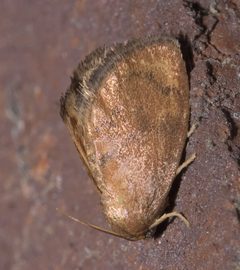
1- Heterogenea shurtleffi(Red-eyed Button Slug Moth)
Heterogenea is a of slug caterpillar moths in the Limacodidae, established by Knoch in 1783. The genus contains two recognized distributed across temperate regions of the Northern Hemisphere. Members of this genus are small with reduced wing venation characteristic of the family. The genus is notable for its disjunct distribution spanning Europe, eastern Asia, and North America.
Pronunciation
How to pronounce Heterogenea: //ˌhɛt.ɛr.oʊˈdʒiː.ni.ə//
These audio files are automatically generated. While they are not always 100% accurate, they are a good starting point.
Identification
Heterogenea are small with relatively broad, rounded wings and reduced wing venation typical of Limacodidae. They can be distinguished from other limacodid by genitalic characters and subtle wing pattern differences. The two species, H. asella and H. shurtleffi, are and separable by geographic range and minor morphological differences in wing pattern and size.
Images
Habitat
Associated with deciduous forests and woodlands. Larval include various broadleaf trees and shrubs.
Distribution
Europe (including Denmark, Norway, and Sweden), easternmost Asia, and northern North America. The two show separation: Heterogenea asella occurs in Europe, while Heterogenea shurtleffi is found in North America.
Seasonality
are active during summer months; specific periods vary by and latitude.
Host Associations
- broadleaf trees and shrubs - larval food plantspecific records are limited
Life Cycle
Complete with , larval, pupal, and stages. Larvae are slug-like caterpillars characteristic of Limacodidae, with reduced and a gliding locomotion. occurs in a cocoon.
Behavior
are and attracted to light. Larvae are slow-moving and feed exposed on leaves.
Ecological Role
Larvae function as herbivores on deciduous vegetation. Their role in is poorly documented but likely includes serving as prey for .
Human Relevance
Occasional minor defoliator of ornamental trees. Not considered economically significant.
Similar Taxa
- other Limacodidae generashare reduced wing venation and slug-like larvae; distinguished by genitalic and wing pattern details
More Details
Taxonomic history
The was established by Knoch in 1783. The two included have been subject to varying taxonomic treatments, with some authors historically treating them as due to their morphological similarity.
Distribution pattern
The trans-Atlantic disjunction between H. asella (Europe) and H. shurtleffi (North America) represents a classic example of amphi-Atlantic distribution in Lepidoptera, likely resulting from Pleistocene range fragmentation.