
Fulgoraecia
Newman, 1851
Species Guides
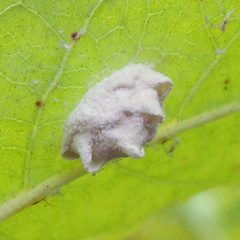
1- Fulgoraecia exigua(Planthopper Parasite Moth)
Fulgoraecia is a of in the Epipyropidae, comprising ectoparasitoid that specialize in parasitizing planthoppers (Hemiptera: ). The genus includes F. melanoleuca, a significant agent of the sugarcane planthopper Pyrilla perpusilla in South Asia. These moths exhibit koinobiont , with larvae feeding externally on nymphs and . The genus has been documented in India and Canada.


Pronunciation
How to pronounce Fulgoraecia: //fʊl.ɡɔːˈriː.ʃə//
These audio files are automatically generated. While they are not always 100% accurate, they are a good starting point.
Identification
Members of Fulgoraecia can be distinguished from other Epipyropidae by their association with fulgoroid planthopper , particularly Pyrilla . are small with reduced mouthparts; larvae are flattened, segmented, and adapted for ectoparasitic life on host . High-resolution images of all life stages of F. melanoleuca have been published for identification reference.
Images
Habitat
Sugarcane agroecosystems; specifically sugarcane fields in tropical and subtropical regions. Overwinters in and pupal (cocoon) stages on leftover sugarcane trash.
Distribution
India (Punjab, Tamil Nadu); Canada (first record of F. exigua).
Seasonality
Active from April through September in Punjab, India, with peaks in September. Overwinters December to March in and cocoon stages. Small peaks in May, decline in June, then increase from July through September.
Host Associations
- Pyrilla perpusilla (Walker) - primary ; ectoparasitoid of nymphs (2nd-5th instars) and sugarcane planthopper (Hemiptera: )
Life Cycle
stage; larval stage (ectoparasitic on ); pupal/chrysalis stage within cocoon; stage. Overwinters predominantly in cocoon stage on sugarcane trash. Total development period varies with host stage: shorter on younger nymphal instars, longer on later instars and adults.
Behavior
-dependent tracking abundance. First instar host nymphs are unsuitable—hosts die without . -induced prolongation of host longevity observed in surviving parasitized nymphs and . Female-biased sex ratio across all host stages.
Ecological Role
Key natural enemy of Pyrilla perpusilla, providing substantial in sugarcane . Total rates reach 25-47% depending on region and season. Candidate for programs.
Human Relevance
Important agent for management of sugarcane planthopper Pyrilla perpusilla, a significant pest of sugarcane in South Asia. Subject of research on mass rearing protocols and augmentative release strategies.
Similar Taxa
- EpipyropsFormerly included now placed in Fulgoraecia; taxonomic revision required to distinguish
- EpiricaniaSynonym or related with which F. melanoleuca has been classified; taxonomic boundaries require clarification
Sources and further reading
- BugGuide
- GBIF taxonomy match
- iNaturalist taxon
- NCBI Taxonomy
- Catalogue of Life
- Biological characteristics of ectoparasitoid, Fulgoraecia melanoleuca (Fletcher) on various stages of its host, Pyrilla perpusilla (Walker)
- Biological anomalies in the sugarcane leafhopper, Pyrilla perpusilla (Walker) due to parasitism by Fulgoraecia melanoleuca (Fletcher) (Lepidoptera: Epipyropidae)
- Seasonal Abundance of Fulgoraecia melanoleuca (Fletcher), a Key Parasitoid of Pyrilla perpusilla (Walker) in Different Agro-Climatic Zones of Punjab, India
- Taxonomy of Fulgoraecia melanoleuca (Fletcher, 1939), (Lepidoptera: Epipyropidae) in India, a biological control agent of Pyrilla perpusilla (Walker) (Hemiptera: Lophopidae)
- First record of the planthopper parasite moth Fulgoraecia exigua (Edwards) (Lepidoptera: Epipyropidae) in Canada, with notes on its collection and hosts
- Lethal and sublethal effects of insecticides on different life stages of Fulgoraecia melanoleuca (Fletcher), a key parasitoid of Pyrilla perpusilla (Walker) in sugarcane
- Biological control of the sugarcane planthopper, Pyrilla perpusilla by the introduction and colonization of ectoparasitoid moth, Epiricania (= Fulgoraecia) melanoleuca in a sugarcane crop island ecosystem
- Effect of cold storage on the fitness of Fulgoraecia melanoleuca (Fletcher) (Lepidoptera: Epipyropidae), an ecto-parasitoid of Pyrilla perpusilla (Walker) (Hemiptera: Lophopidae)
- Occurrence of Fulgoraecia (= Epiricania) melanoleuca (Lepidoptera: Epipyropidae) as a parasitoid of sugarcane lophopid planthopper Pyrilla perpusilla in Tamil Nadu (India) with brief notes on its life stages