
Philonome clemensella
Chambers, 1874
Clemens' Philonome Moth
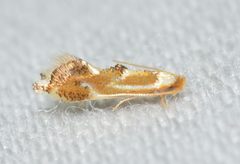
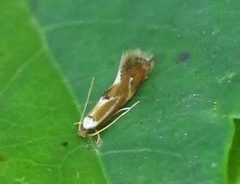
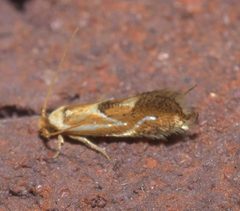
Philonome clemensella is a small in the Tineidae, native to eastern North America. are recognized by distinctive orange-brown forewings marked with white diagonal lines and scattered black tufts. The was historically classified in Lyonetiidae but reassigned to Tineidae based on 2013 genetic evidence. Larval remains poorly documented despite historical associations with hickory and linden.
Pronunciation
How to pronounce Philonome clemensella: //faɪˈlɒnoʊmi ˌklɛmɛnˈsɛlə//
These audio files are automatically generated. While they are not always 100% accurate, they are a good starting point.
Identification
Distinguished from similar small tineid moths by the combination of orange-brown ground color, two white diagonal forewing lines with the line turning parallel to the , and the specific pattern of black tufts. The postmedial line's characteristic widening at the costa and narrowing toward the margin is particularly distinctive. Wing shape—narrow and tightly folded—differs from many related with broader, more loosely held wings.
Images
Habitat
Specific requirements are undocumented. have been collected across a broad geographic range suggesting adaptability to varied conditions within eastern deciduous forest regions.
Distribution
Eastern North America from Oklahoma and Minnesota eastward to Florida and Maine, including southeastern Canada. Records include Vermont.
Seasonality
active from April through November, with peak abundance in June and July.
Life Cycle
Complete with , larva, pupa, and stages. Larval is unknown; historical reports of association with hickory (Carya) and linden (Tilia) trees are now considered unreliable due to ambiguous specimen label data, and no verified larval observations from these or any have been reported.
Behavior
are and attracted to light. Resting posture with wings folded tightly around the body is characteristic.
Human Relevance
No documented economic or health significance. Occasionally encountered by naturalists and enthusiasts.
Similar Taxa
- Other Philonome speciesShare -level characteristics including small size and wing folding posture; distinguished by specific forewing pattern elements
- Lyonetiidae species (historical classification)Formerly grouped together based on superficial similarity; genetic data separated them, and wing pattern details differ
Misconceptions
Long classified in the leaf-miner Lyonetiidae; a 2013 genetic study demonstrated placement in Tineidae. Historical larval records for hickory and linden are now regarded as unsubstantiated.
More Details
Taxonomic history
Originally described by Chambers in 1874. Reassigned from Lyonetiidae to Tineidae based on molecular phylogenetic analysis published in 2013, resolving long-standing classification uncertainty.
Data gaps
Larval , feeding habits, and plant relationships remain completely unknown despite the being relatively well-collected as .