
Amydria effrentella
Clemens, 1859
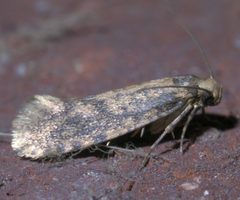
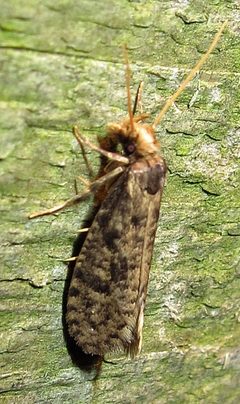
Amydria effrentella is a small in the Tineidae, originally described from North America in 1859. It is widely distributed across eastern, central, and western North America, with records from the United States and Canada. The has a wingspan of approximately 24 mm and is recognized by its mottled forewings with a distinct dark patch at the end of the . Larvae are that feed on decaying leaves and have been documented in association with the lodges of the mountain beaver (Aplodontia rufa).
Pronunciation
How to pronounce Amydria effrentella: //əˈmɪdɹiə ɛfˈfɹɛntɛlə//
These audio files are automatically generated. While they are not always 100% accurate, they are a good starting point.
Identification
The combination of small size (~24 mm wingspan), mottled forewings, and the distinctive dark patch at the end of the distinguishes this from similar Amydria. Definitive identification to species level within Amydria often requires dissection of genitalia, as external can be similar among .
Images
Habitat
Associated with forested environments where decaying leaf litter accumulates. Larvae have been found within remaining leaves of branches used in older lodges of Aplodontia rufa (mountain beaver), suggesting proximity to this mammal's in western North America.
Distribution
North America: United States (Alabama, Arizona, Arkansas, California, Georgia, Illinois, Indiana, Kentucky, Maryland, Massachusetts, Minnesota, Mississippi, Nevada, New Jersey, New York, North Carolina, Ohio, South Carolina, Tennessee, Utah, West Virginia, Wisconsin) and Canada (New Brunswick, Quebec, Saskatchewan, Alberta, Manitoba, Vermont border region).
Diet
Larvae are , feeding on decaying leaves.
Host Associations
- Aplodontia rufa - associationLarvae found in remaining leaves of branches used in older mountain beaver lodges
Life Cycle
Complete (, larva, pupa, ). Specific details of development duration, number of per year, and stage not documented in available sources.
Behavior
are and attracted to ultraviolet light. Larvae inhabit decaying leaf material.
Ecological Role
Larvae contribute to decomposition of leaf litter as . Specific role in nutrient cycling or interactions not documented.
Human Relevance
No documented economic importance. Occasionally encountered during surveys and blacklighting events.
Similar Taxa
- Amydria pseudopsalta confusellaSimilar external ; distinguished by genitalia dissection
- Other Amydria speciesExternal features often insufficient for -level identification without dissection