
Parnassiinae
snow Apollos, Parnassians
Tribe Guides
1- Parnassiini(True Parnassians)
Parnassiinae is a of swallowtail butterflies (Papilionidae) comprising approximately 50 medium-sized . Members are predominantly white or yellow in coloration and are strongly associated with high-altitude mountain across the Northern Hemisphere. The subfamily is divided into three tribes: Luehdorfiini, Parnassiini, and Zerynthiini. Phylogenetic studies indicate the group originated in the late Paleocene (ca. 57 Ma) in the Western Palearctic and Western Asia, with subsequent diversification and to Central Asia, the Himalayas, and North America.
Pronunciation
How to pronounce Parnassiinae: //pɑːrˈnæsɪ.aɪˌniː//
These audio files are automatically generated. While they are not always 100% accurate, they are a good starting point.
Identification
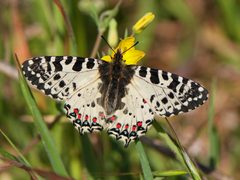
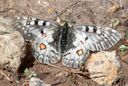
Distinguished from other Papilionidae by combination of medium size, white or yellow coloration, and high-altitude distribution. The tribe Zerynthiini (False Apollos) includes with more complex patterns and different plant associations. Parnassiini (true Apollos) typically show cleaner white or yellow wings with black spotting. Luehdorfiini contains the single Luehdorfia with distinctive . Absence of tails on hindwings separates most Parnassiinae from many other swallowtails, though some Papilioninae also lack tails.
Images
Habitat
High-altitude mountain environments, including alpine meadows, rocky slopes, and subalpine zones. Distribution closely tied to orogeny and mountain-building processes, particularly in the Qinghai-Tibet Plateau and neighboring regions. Some occupy lower elevations in Central East China, likely representing secondary from high-altitude ancestors.
Distribution
Northern Hemisphere: Asia (highest diversity in Qinghai-Tibet Plateau and Xinjiang, China), Europe, and North America. Origin in Western Palearctic + Western Asia and Caucasus regions (late Paleocene, ca. 57 Ma), with subsequent to Central Asia and the Himalayas. North America colonized by two independent dispersal events via subgenera Driopa and Parnassius.
Seasonality
times vary by and elevation; some show partly divergent flight times across geographic range (e.g., western Turkey/Greece versus Levant populations in Archon apollinus). Activity generally constrained to warmer months at high altitudes.
Host Associations
- Papaveraceae - plantAssociated with of subgenus Driopa to North America; specific records at level not detailed in sources
- Crassulaceae - plantAssociated with of subgenus Parnassius to North America; specific records at level not detailed in sources
- Aristolochia - plantConfirmed for Zerynthia including Z. polyxena; caterpillars feed on highly poisonous Aristolochia species
Life Cycle
Complete with , larva (caterpillar), pupa, and stages. Significant morphological and ethological differences in caterpillars and pupae documented between geographically separated of some (e.g., Archon apollinus lineages). Specific developmental duration and stage vary by species and are not well documented in available sources.
Behavior
Geographic ranges expand during glacial periods and contract during interglacial periods due to interruption of . Ancient gene has been detected and may have contributed to spread to different altitudes. Male-biased detected in some (e.g., Parnassius glacialis), potentially causing incongruence between mitochondrial and nuclear genetic patterns. Isolation-by-distance pattern observed in both low-altitude and high-altitude .
Ecological Role
Considered a model organism group for investigating climate change effects on alpine in the Northern Hemisphere. Serves as for specialized including ichneumonid wasps (e.g., Agrypon polyxenae parasitizing Zerynthia polyxena).
Human Relevance
Subject of extensive phylogenetic and biogeographic research due to value for understanding climate change impacts on alpine . Some likely of interest to collectors given distinctive appearance and restricted high-altitude distributions.
Similar Taxa
- PapilioninaeOther of Papilionidae; distinguished by generally larger size, more diverse coloration including black and yellow patterns, many with tailed hindwings, and predominantly lower-elevation distributions
- BaroniinaeOther of Papilionidae; and restricted to Mexico, distinguished by different wing venation and plant associations
More Details
Phylogenetic Tribes
The comprises three tribes: Luehdorfiini ( Luehdorfia), Parnassiini (true Apollos, genus Parnassius with eight recognized subgenera), and Zerynthiini (False Apollos, genera including Zerynthia and Archon). Each tribe shows distinct biogeographic and ecological patterns.
Fossil Record
Two fossil are recognized: †Thaites ruminiana (late Oligocene) and †Doritites bosniaskii (late Miocene), both from the Western Palearctic. These fossils were critical in revising the 's origin from a late Eocene Central Asian origin to a late Paleocene Western Palearctic origin.
Quaternary Dynamics
Pleistocene glacial-interglacial cycles have strongly shaped current distribution patterns. divergence in Parnassius glacialis dated to ca. 0.95 Ma during the middle Pleistocene transition, with clade formation associated with the Kunlun-Huanghe tectonic movement.
Sources and further reading
- BugGuide
- Wikipedia
- iNaturalist taxon
- NCBI Taxonomy
- Bayesian Total-Evidence Dating Reshapes the Age and Historical Biogeography of Parnassiinae
- Phylogeny and Biogeographic History of Parnassius Butterflies (Papilionidae: Parnassiinae) Reveal Their Origin and Deep Diversification in West China
- Discordance between biological and genetic traits highlights complex evolutionary history in the False Apollo, Archon apollinus (Herbst, 1798) (Lepidoptera, Papilionidae, Parnassiinae)
- AGRYPON POLYXENAE (SZÉPLIGETI, 1899) (HYMENOPTERA: ICHNEUMONIDAE: ANOMALONINAE); NEWLY RECORDED PARASITOID OF ZERYNTHIA POLYXENA (DENIS & SCHIFFERMÜLLER, 1775) (LEPIDOPTERA: PAPILIONIDAE: PARNASSIINAE) IN THE FAUNA OF SERBIA
- Spatiotemporal Differentiation of Alpine Butterfly Parnassius glacialis (Papilionidae: Parnassiinae) in China: Evidence from Mitochondrial DNA and Nuclear Single Nucleotide Polymorphisms