
Parides
Hübner, [1819]
cattlehearts
Species Guides
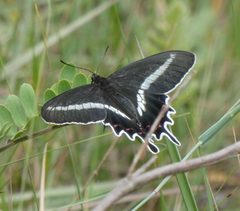
1- Parides alopius(white-dotted cattleheart)
Parides, commonly called cattlehearts, is a of medium-sized swallowtail butterflies in the Papilionidae. The genus comprises approximately 40 distributed throughout the . Members are characterized by predominantly black or dark brown wings with contrasting bright spots in green, red, yellow, or pink. The genus exhibits Müllerian mimicry, with species sharing similar aposematic coloration that advertises their to .
Pronunciation
How to pronounce Parides: /ˈpaːr.i.deːs/
These audio files are automatically generated. While they are not always 100% accurate, they are a good starting point.
Identification
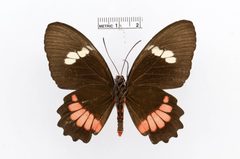
Distinguishing individual Parides in the field is often difficult or impossible due to convergent aposematic coloration among and with other toxic species. The combination of medium size, black wings with contrasting colored spots (green on forewings, red on hindwings in most species), and the general absence of hindwing tails (except in P. gundlachianus) characterizes the . Females may be distinguished from males by their additional white and pink spotting. Species-level identification typically requires examination of androconial structures or molecular analysis.
Images
Appearance
Medium-sized butterflies with wings that are predominantly silky black or dark brown. Forewings typically bear bright green spots, while hindwings display red or yellow spots; females often have white and bright pink spots with considerable variation in size and number. Almost all lack tails on the hindwings, with Parides gundlachianus being the sole exception. In some species, the inner edge of the hindwing is expanded into a pale, lobe-like structure.
Habitat
Found in diverse Neotropical ; specific requirements vary by . Many species occur in tropical and subtropical forests, forest edges, and associated open areas. The plant association with Aristolochia species influences local distribution patterns.
Distribution
Restricted to the Americas, occurring throughout the Neotropical ecozone. are distributed from Mexico through Central America and across South America, with varying ranges among individual species. Some species have restricted distributions, such as Parides gundlachianus to Cuba and Parides burchellanus in southeastern Brazil.
Diet
feed on nectar; larvae feed exclusively on of Aristolochia (pipevines, Aristolochiaceae).
Host Associations
- Aristolochia - larval plantCaterpillars feed exclusively on pipevine , sequestering toxic aristolochic acids
Life Cycle
Complete with , larva, pupa, and stages. Larvae feed on Aristolochia plants, sequestering toxins that render both larvae and adults unpalatable to .
Behavior
are and active during daylight hours. The bright, contrasting wing coloration serves as aposematic (warning) signals to visually hunting , advertising the butterflies' derived from larval plant .
Ecological Role
of nectar sources. As herbivores on Aristolochia, larvae play a role in plant-insect coevolutionary dynamics. The of aristolochic acids makes Parides models for Müllerian mimicry rings, influencing the evolution of coloration in other species.
Human Relevance
Collected for scientific study and private collections; specimens require careful preparation including relaxing and spreading. Some are of conservation concern due to loss and restricted ranges. Parides burchellanus has been listed among the world's 100 most threatened species.
Similar Taxa
- Other PapilionidaeParides lack the hindwing tails characteristic of many other swallowtail (except P. gundlachianus), and have distinctive spot patterns on dark wings
- Mimetic non-Parides butterfliesOther toxic or unpalatable may share similar aposematic black-and-bright-spot coloration through Müllerian mimicry, making field identification challenging
More Details
Taxonomic complexity
The has undergone significant taxonomic revision, with groupings based on morphological and molecular data. The 'panthonus clade' was recently redefined to comprise two species (P. burchellanus and P. panthonus) based on molecular phylogenetic analysis. Some species placements remain disputed or tentative.
Conservation status
Parides burchellanus was listed among the IUCN/ZSL '100 Most Threatened ' in 2012, highlighting conservation concerns for certain members of this with restricted distributions.