
Papilio joanae
Heitzman, 1974
Ozark Swallowtail
Papilio joanae, the Ozark swallowtail, is a North American in the Papilionidae. It was formerly considered a synonym of the black swallowtail (Papilio polyxenes) but is now recognized as a distinct . Mitochondrial analysis indicates it is more closely related to the Old World swallowtail (Papilio machaon) than to P. polyxenes. The species is to the Ozark Mountains and is uncommon to rare throughout its restricted range.
Pronunciation
How to pronounce Papilio joanae: //pəˈpɪli.oʊ dʒoʊˈænaɪ//
These audio files are automatically generated. While they are not always 100% accurate, they are a good starting point.
Identification
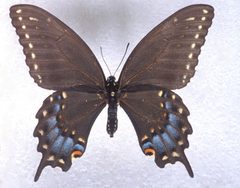
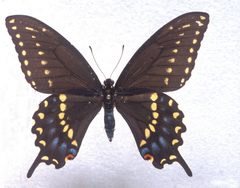
Distinguished from Papilio polyxenes by hindwing eyespot pupil position (touching inner margin edge versus not) and by orange spots on hindwing underside that lack yellow. Caterpillars are distinguished from P. polyxenes by and plant associations rather than . Mitochondrial analysis provides definitive separation from P. polyxenes.
Images
Appearance
are almost identical in appearance to the black swallowtail (Papilio polyxenes). Key distinguishing features include: on both surfaces of the hindwing, the pupil in the eyespot usually touches the edge of the inner margin; on the underside of the hindwing, the orange spots contain very little or no yellow. The black adult color pattern is presumed to be inherited as a simple autosomal . Caterpillars are morphologically very similar to black swallowtail caterpillars.
Habitat
Cedar glades and woodland in the Ozark Mountains.
Distribution
to the Ozark Mountains in the United States. Uncommon to rare throughout its range.
Seasonality
observed from April to September. Two per year.
Diet
Larvae feed on: Thaspium barbinode (meadow parsnip), integerrima (yellow pimpernel), and Zizia aurea (golden alexander). diet not specified in sources.
Host Associations
- Thaspium barbinode - larval meadow parsnip
- Taenidia integerrima - larval yellow pimpernel
- Zizia aurea - larval golden alexander
Life Cycle
Two per year. Caterpillars morphologically similar to black swallowtail caterpillars. Chrysalis and pupal stages not described in available sources.
Similar Taxa
- Papilio polyxenesFormerly considered ; nearly identical in appearance but distinguished by hindwing eyespot pupil position and orange spot coloration on hindwing underside; caterpillars distinguished by and plant preferences
- Papilio machaonMitochondrial analysis indicates P. joanae is more closely related to this Old World than to P. polyxenes, despite morphological similarity to the latter
Misconceptions
Once considered a synonym of Papilio polyxenes; later recognized as distinct based on genetic and subtle morphological differences.
More Details
Taxonomic history
Originally described as a synonym of Papilio polyxenes, later elevated to status based on mitochondrial analysis showing closer relationship to Papilio machaon
Conservation status
Uncommon to rare throughout its restricted range in the Ozark Mountains
Sources and further reading
- BugGuide
- Wikipedia
- GBIF taxonomy match
- iNaturalist taxon
- NCBI Taxonomy
- Catalogue of Life
- Bird droppings, snake eyes, dead leaves: Swallowtails, Papilio spp. — Bug of the Week
- Papilionoidea | Blog
- Swallowtails where art thou? Swallowtail butterflies, Papilionidae — Bug of the Week
- Parsley poacher: Black swallowtail caterpillar, Papilio polyxenes — Bug of the Week
- Swallowtail soiree - Papilio glaucus — Bug of the Week
- Swallowtail soiree – Eastern tiger swallowtail, Papilio glaucus — Bug of the Week