
Polyommatus icarus
(von Rottemburg, 1775)
Common Blue Butterfly, European Common Blue
Polyommatus icarus is one of the most widespread butterflies in the Palaearctic region, ranging from the Atlantic to the Pacific Ocean. The exhibits strong sexual dichromatism: males display uniform blue structural coloration on wing surfaces produced by photonic crystal-type nanoarchitectures, while females are typically brown dorsally with variable blue coloration frequency across geographic regions (0.05% in northern to 5% in southern populations). The species has been introduced to North America, with established populations in Quebec since 2005. Caterpillars are facultatively myrmecophilous, forming protective associations with ants through secretions from the dorsal nectar organ.
Pronunciation
How to pronounce Polyommatus icarus: //ˌpɒliˈɒmətəs ˈaɪkərəs//
These audio files are automatically generated. While they are not always 100% accurate, they are a good starting point.
Identification
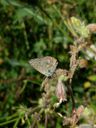
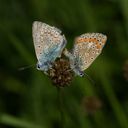
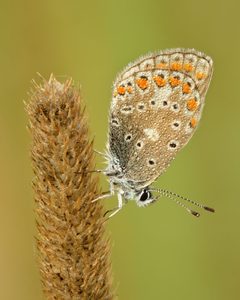
Males are distinguished by bright blue wing surfaces with black-brown borders and white fringes, produced by photonic crystal-type nanoarchitectures rather than pigments. Females are typically brown dorsally with orange submarginal spots, though blue coloration occurs in 0.05-15% of females depending on geographic origin. Both sexes share identical complex pigmentary patterns on wing surfaces featuring orange and black spots on grey-brown background, used for identification. Distinguished from cryptic Polyommatus celina by genetic divergence exceeding 5% at COI and subtle morphometric differences; the two species occur in parapatry in Iberia and completely exclude each other on islands.
Images
Habitat
Occurs across diverse climatic and biogeographical regions from Scandinavia to Sicily and Crete. In introduced Canadian range, abundance is highest at sites with moderate disturbance levels (mowed every 2-3 years), presence of preferred larval plants, and low proportional grass cover. At landscape , abundance increases with urban area proportion and decreasing forest cover.
Distribution
Native to Palaearctic region from Atlantic to Pacific Ocean; Europe from Scandinavia to Sicily and Crete. Most widespread lycaenid in the Palaearctic. Introduced to Quebec, Canada in 2005, where it has become successfully established and may expand in disturbed and urban areas. Northern in Scotland and Sweden have period June-September.
Seasonality
period June-September in northern range limits (Scotland, Sweden). Multiple annually: 1 generation at northern range limit, 3-5 generations in southern part of range.
Diet
feed on nectar from various flowers. Larvae feed on inflorescences and foliage of multiple plant including Medicago sativa, Lotus corniculatus, Melilotus officinalis, and Coronilla varia. Larval growth rates and weights are highest when fed flowers rather than foliage; flower-fed caterpillars achieve 2-fold higher secretion rates from the nectar organ in associations.
Life Cycle
Overwinters as half-grown larvae (second or third instar); last enters . Pupae may be exposed to low temperatures for several days before period in northern regions. Prolonged cold stress (5°C for 10-62 days) applied to pupae induces aberrant coloration: pigmentary patterns show proportional responses to cooling duration, while structural coloration shows individual variation in males and induced blue coloration in normally brown females.
Behavior
Facultatively myrmecophilous: caterpillars secrete sugar-rich droplets from the nectar organ to attract ants, primarily Lasius , for protection from and . In introduced Quebec range, has formed novel mutualistic interaction with native Lasius neoniger. Estimated lifetime secretion volume ranges 2-5 μl in most food treatments (1.6-5.5% of prepupal fresh weight), with higher investment on Coronilla varia flowers (7.8-12.3%). Females preferentially oviposit on flowering Lotus corniculatus plants over non-flowering plants, with oviposition often immediately following nectaring. are low to moderate dispersers relative to other butterflies. Visual system uses duplicated blue opsin (BRh2) in conjunction with long-wavelength opsin to perceive green light up to 560 nm; cannot discriminate colors in red range (570-640 nm).
Ecological Role
as . Larval plant relationships influence interactions through facultative myrmecophily. In introduced Canadian range, occupies with native lycaenid Glaucopsyche lygdamus but with different , potentially facilitating coexistence.
Human Relevance
Popular subject for ecological and evolutionary research due to widespread distribution and tractability. Introduced in North America provide case study for invasion and novel mutualism formation. Subject of citizen science monitoring and conservation concern: fine- studies reveal 74% population decline since 1901 in some British landscapes, undetected by coarse grid-based assessment methods.
Similar Taxa
- Polyommatus celinaCryptic occurring in parapatry in Iberia and allopatry on Mediterranean islands; distinguished by >5% COI genetic divergence and subtle morphometric differences, though morphologically and ecologically similar with overlapping plant use.
- Glaucopsyche lygdamusNative North American lycaenid with which P. icarus co-occurs in introduced Quebec range; both interact with Lasius neoniger ants but have different phenologies.
Sources and further reading
- BugGuide
- GBIF taxonomy match
- iNaturalist taxon
- NCBI Taxonomy
- Catalogue of Life
- National Meadows Day 2022 in Scotland - Buglife Blog - Buglife
- National Meadows Day 2023 in Scotland - Buglife Blog - Buglife
- Stories about small insects and making a big difference - Buglife Blog - Buglife
- Comparative Cytogenetics | Blog - Part 2
- taxonomy | Blog - Part 18
- Novel mutualistic interaction in introduced <i>Polyommatus icarus</i> larvae in Quebec.
- A combined genetic‐morphometric analysis unravels the complex biogeographical history of Polyommatus icarus and Polyommatus celina Common Blue butterflies
- Changes in structural and pigmentary colours in response to cold stress in Polyommatus icarus butterflies
- The lycaenid butterfly Polyommatus icarus uses a duplicated blue opsin to see green
- Sequestration and distribution of flavonoids in the common blue butterfly Polyommatus icarus reared on Trifolium repens
- The influence of diet on growth and secretion behaviour of myrmecophilous Polyommatus icarus caterpillars (Lepidoptera: Lycaenidae)
- Flavonoid sequestration by the common blue butterfly Polyommatus icarus: quantitative intraspecific variation in relation to larval hostplant, sex and body size
- The role of nectar sources for oviposition decisions of the common blue butterfly Polyommatus icarus
- Detecting decline in a formerly widespread species: how common is the common blue butterfly Polyommatus icarus?
- Anthropogenic disturbance promotes the abundance of a newly introduced butterfly, the European common blue (Polyommatus icarus; Lepidoptera: Lycaenidae), in Canada