
Chionodes trichostola
(Meyrick, 1923)
Chionodes trichostola is a gelechiid described by Meyrick in 1923. It occurs across western North America from southwestern British Columbia to Texas. The exhibits in wingspan, with males measuring approximately 19 mm and females 16 mm. Larvae have been documented feeding on multiple oak species and related plants.
Pronunciation
How to pronounce Chionodes trichostola: //kiˈoʊnəˌdiːz trɪkoʊˈstoʊlə//
These audio files are automatically generated. While they are not always 100% accurate, they are a good starting point.
Identification
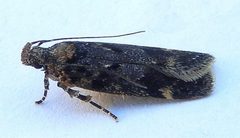
Distinguished from similar Chionodes by combination of: small blackish linear mark beneath near base; elongate black spot at base; specific arrangement of cloudy blackish stigmata with plical very obliquely before first discal; presence of whitish beyond first discal and before second stigma; angulated transverse streak at three-fourths. Sexual size difference (male 19 mm, female 16 mm) provides additional distinguishing character. Genitalia examination may be required for definitive separation from .
Images
Appearance
Small with sexually dimorphic size. Forewings brown with irregular dark fuscous irroration. Small blackish linear mark beneath near base. Elongate black spot at base of dorsum. Oblique streak from costa to plical stigma indicated by dark suffusion with two small blackish spots. Stigmata cloudy blackish; plical stigma very obliquely before first discal stigma, which tends to form oblique mark. Two or three whitish beyond first discal and before second stigma. Angulated transverse streak of brown ground colour at three-fourths. Hindwings grey.
Habitat
Associated with oak woodland and related scrub . Larval plants include evergreen and deciduous oak , indicating occupancy of oak-dominated . Occurs from low elevations in coastal California to montane areas in interior western states.
Distribution
North America: southwestern British Columbia, California, Utah, Colorado, Arizona, and Texas. Records suggest primarily western distribution with eastern extent in Texas.
Diet
Larvae feed on Quercus chrysolepis (canyon live oak), Quercus douglasii (blue oak), Quercus kelloggii (California black oak), Quercus lobata (valley oak), Quercus wislizenii (interior live oak), Quercus dumosa (coastal sage scrub oak), Quercus tomentella (island oak), Arctostaphylos insularis (island manzanita), and Sorbus .
Host Associations
- Quercus chrysolepis - larval food plantcanyon live oak
- Quercus douglasii - larval food plantblue oak
- Quercus kelloggii - larval food plantCalifornia black oak
- Quercus lobata - larval food plantvalley oak
- Quercus wislizenii - larval food plantinterior live oak
- Quercus dumosa - larval food plantcoastal sage scrub oak
- Quercus tomentella - larval food plantisland oak
- Arctostaphylos insularis - larval food plantisland manzanita
- Sorbus - larval food plant level
Ecological Role
Larval herbivore on oaks and related woody plants. Contributes to leaf damage in oak ; specific ecological impacts unquantified.
Human Relevance
Minor potential significance in oak woodland management due to larval feeding on multiple native oak . No documented economic importance.
Similar Taxa
- Other Chionodes speciesMany share brown forewing coloration and similar size; definitive identification requires examination of specific wing pattern elements (stigma arrangement, presence of whitish , angulated transverse streak) and potentially genitalia
More Details
Host plant diversity
Unusually broad larval range spanning multiple oak sections (Quercus, Protobalanus) and even different (Arctostaphylos, Sorbus), suggesting either polyphagy or potential cryptic requiring further study.
Island endemics
Larval records from Quercus tomentella (island oak) and Arctostaphylos insularis (island manzanita), both Channel Islands endemics, indicate occurrence on California Channel Islands.