
Chionodes occidentella
(Chambers, 1875)
Black-smudged Chionodes Moth
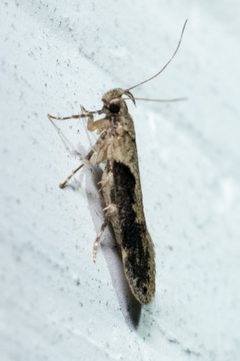
Chionodes occidentella is a small gelechiid with a wingspan of 18-19.5 mm, distributed from British Columbia through California to Arizona. The exhibits distinctive forewing patterning combining brown and ochreous . Larvae have been documented feeding on multiple woody plant species across three , with particular association with oaks and ceanothus.
Pronunciation
How to pronounce Chionodes occidentella: /ki.ˈoʊ.nə.dez ˌɒk.sɪ.dɛn.ˈtɛ.lə/
These audio files are automatically generated. While they are not always 100% accurate, they are a good starting point.
Identification
Distinguished from similar Chionodes by the specific forewing pattern: curved ochreous pre-ciliary fascia concave toward base, combined with two small oblique velvety-brown streaks in the disc before the middle. The color balance of approximately equal brown and ochreous, with dark brown costal base and middle costal patch, provides additional diagnostic characters. Exact species-level identification within the Chionodes occidentella complex may require dissection or genitalia examination.
Images
Appearance
Forewings clothed with approximately equal proportions of brown and ochreous . Costal basal portion ochreous, transitioning to greyish-ochreous and brown on margin. Extreme base of dark brown. Costal part of middle wing dark brown; dorsal margin at same position pale brown. Two small oblique velvety-brown streaks present in brown portion of disc before middle. Curved ochreous fascia just before cilia, concave toward base, distinct on both margins but indistinct centrally due to intermixed brown scales. Apex behind fascia brown.
Habitat
Associated with supporting its documented larval plants: oak woodlands, chaparral, and montane shrub . Specific microhabitat preferences for are not documented.
Distribution
Recorded from British Columbia south through California to Arizona. GBIF distribution records confirm presence in Canada (British Columbia) and United States.
Diet
Larvae feed on: Quercus agrifolia (coast live oak), Quercus douglasii (blue oak), Ceanothus thyrsiflorus (blueblossom), Ceanothus sorediatus (Jim Brush), Cercocarpus betuloides (birchleaf mountain-mahogany), and Arctostaphylos patula (greenleaf manzanita). feeding habits are not documented.
Host Associations
- Quercus agrifolia - larval Fagaceae
- Quercus douglasii - larval Fagaceae
- Ceanothus thyrsiflorus - larval Rhamnaceae
- Ceanothus sorediatus - larval Rhamnaceae
- Cercocarpus betuloides - larval Rosaceae
- Arctostaphylos patula - larval Ericaceae
Ecological Role
Larval herbivore on woody shrubs and trees; specific ecological impacts or trophic relationships beyond herbivory are not documented.
Human Relevance
No documented economic or cultural significance. Not known as a pest .
Similar Taxa
- Other Chionodes speciesSimilar size and general gelechiid ; distinguished by specific forewing pattern elements including the curved ochreous pre-ciliary fascia and discal streaks
- Chionodes occidentella complex membersiNaturalist treats this as a ; precise identification may require examination of genitalia or molecular data
More Details
Taxonomic Note
iNaturalist classifies this as a 'complex' (Chionodes occidentella complex), suggesting potential cryptic diversity or unresolved boundaries within this group.
Host Plant Breadth
Documented larval span three plant (Fagaceae, Rhamnaceae, Rosaceae, Ericaceae), indicating broad dietary rather than strict specialization.