
Parancistrocerus perennis anacardivora
(Rohwer, 1915)
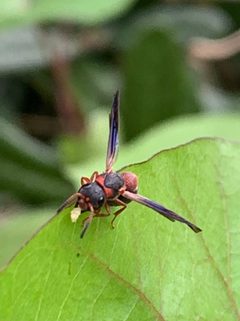
Parancistrocerus perennis anacardivora is a southern of the mason wasp Parancistrocerus perennis, distinguished by reddish markings along the side of the first abdominal segment. It is a small solitary with a wing length of 6-8 millimeters. Females hunt caterpillars to provision nest in hollow twigs or pre-existing cavities, paralyzing prey with their sting. The subspecies ranges from southern Ontario to Florida and west to the Mississippi River, with anacardivora occurring in the southern portion of this range.
Pronunciation
How to pronounce Parancistrocerus perennis anacardivora: /ˌpærənˌsɪstroʊˈsɪrəs pəˈrɛnɪs ˌænəˌkɑrˈdɪvərə/
These audio files are automatically generated. While they are not always 100% accurate, they are a good starting point.
Identification
Difficult to distinguish from Stenodynerus based on images of live specimens; microscopic examination of actual specimens often required for definitive identification. The anacardivora can be recognized by reddish markings along the side of the first abdominal segment, though this trait is limited to southern specimens. Specimens west of the Mississippi River are rare; the species has been recorded only in Kansas west of the river.
Images
Habitat
Utilizes pre-existing cavities including hollow twigs, particularly sumac, and borings in dead wood. Will occupy artificial nest blocks with holes of appropriate diameter. Nesting sites are typically in sheltered, south-facing locations at least three feet above ground.
Distribution
Southern portion of the range, from southern Ontario to Florida and west to the Mississippi River. The nominate occurs in northern areas; anacardivora occurs in southern regions. West of the Mississippi River, the species has been recorded only in Kansas.
Seasonality
Active through the growing season; observed nectaring on wildflowers and hunting caterpillars. One observation from New Jersey on October 18 suggests late-season activity in northern parts of the range.
Diet
females hunt caterpillars of the Coleophoridae () and Tortricidae (leafroller moths) to provision nest . Adults nectar on wildflowers including boneset, rattlesnake master, and goldenrod .
Life Cycle
Females construct multi-celled nests in hollow twigs or cavities, building from the bottom up. Each is provisioned with multiple paralyzed caterpillars, followed by a single laid on the last victim. Cells are sealed with partitions of sand glued together with saliva. Development occurs within the sealed cell, with larvae feeding on the provided caterpillars.
Behavior
Solitary nesting . Females hunt caterpillars that are concealed in leaf rolls or protective cases, subduing them with a sting. Hunting success against well-protected prey such as tortricid leafrollers (which can escape by dropping on silk threads) and coleophorid casebearers (which live inside hardened fecal cases) has been observed despite these defenses.
Ecological Role
of caterpillars in Coleophoridae and Tortricidae. Serves as potential for parasitic in family Sapygidae, which lay in provisioned nests.
Human Relevance
Beneficial as of caterpillar pests. Will occupy artificial / blocks, making it observable for study and photography. Can be attracted to gardens with appropriate nesting and floral resources.
Similar Taxa
- Stenodynerus speciesExtremely similar in appearance; cannot be distinguished from Parancistrocerus perennis based on images of live specimens in most cases; microscopic examination required
- Parancistrocerus perennis (nominate subspecies)Lacks the reddish lateral markings on the first abdominal segment characteristic of southern anacardivora specimens
More Details
Nesting Biology
Females prefer sumac twigs among natural nesting substrates. Artificial nests can be created by drilling holes of various diameters into wood blocks or bundling old sumac twigs, placed in south-facing sheltered locations at least three feet above ground.
Taxonomic History
Identification confirmed by Dr. Matthias Buck at the Royal Alberta Museum from photographic images, demonstrating the difficulty of field identification for this group.