
Episyron
Schiødte, 1837
Species Guides
4- Episyron biguttatus(Two-spotted Spider Wasp)
- Episyron conterminus
- Episyron quinquenotatus(Five-spotted Spider Wasp)
- Episyron snowi
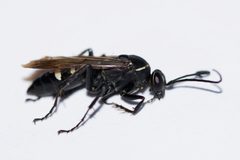
Episyron is a of spider wasps in the Pompilidae. Members are medium to large-sized that construct ground nests in sandy substrates and provision them with paralyzed spiders. Nine occur in Europe, with additional species documented in North America including the northeastern United States.
Pronunciation
How to pronounce Episyron: /ɛpɪˈsaɪrɒn/
These audio files are automatically generated. While they are not always 100% accurate, they are a good starting point.
Identification
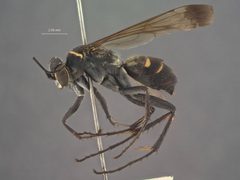
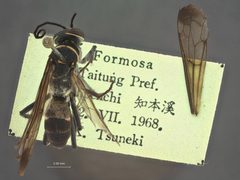
Medium to large pompilid wasps with distinctive long, dark clustered hairs on and combined with spotted . Ground-nesting in sandy and association with spider prey ( Araneidae, Lycosidae, Tetragnathidae) aid recognition. Separation from other Pompilidae requires examination of detailed morphological characters not fully documented in available sources.
Images
Appearance
Medium to large body size. and covered with long, dark clustered hairs. spotted in pattern.
Habitat
Open sandy with loose soil substrates suitable for burrow excavation. Ground-nesting requirements dictate preference for areas where females can dig easily.
Distribution
Europe (nine ), northeastern United States, and additional records from Denmark, Norway, Sweden, and Vermont.
Diet
: not specified in sources. Larvae: fed paralyzed spiders of Araneidae, Lycosidae, and Tetragnathidae.
Host Associations
Life Cycle
Females construct underground nests in sandy soil. Nests are provisioned with paralyzed spiders as food for developing larvae. are laid on the spiders. Developmental stages include egg, larva (feeding on provisioned spider), pupa, and .
Behavior
Females excavate burrows in sandy substrates for nesting. Paralyzed spiders are transported to nests as larval provisions. Nesting sequence includes site selection, burrow construction, prey transport, oviposition on , and nest closure.
Ecological Role
control of spiders through . Soil disturbance and nutrient cycling through burrowing activity.
Similar Taxa
- Other Pompilidae generaMany pompilid wasps share ground-nesting and spider ; Episyron distinguished by combination of size, hair pattern, and spotted , though precise differentiating characters require examination
More Details
Taxonomic note
The Episyron quinquenotatus has been specifically studied for nesting in the northeastern United States, but detailed behavioral data for the genus as a whole remains limited.
Sources and further reading
- BugGuide
- Wikipedia
- GBIF taxonomy match
- iNaturalist taxon
- NCBI Taxonomy
- Catalogue of Life
- Comparative Nesting Behavior of Episyron quinquenotatus (Hymenoptera: Pompilidae) in the Northeastern United States
- COMPARATIVE NESTING BEHAVIOR OF EPISYRON QUINQUENOTATUS (HYMENOPTERA: POMPILIDAE) IN THE NORTHEASTERN UNITED STATES