
Mutillinae
Tribe Guides
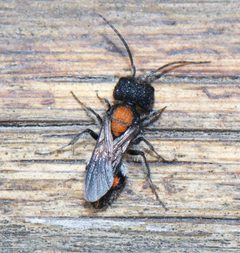
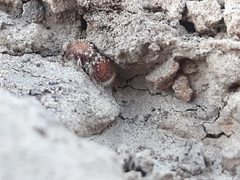
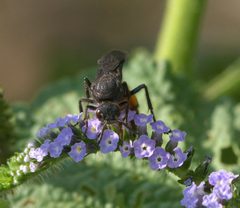
1Mutillinae is a of velvet ants ( Mutillidae), a group of solitary . Members are characterized by dense, often brightly colored setae and extreme : males are winged while females are wingless. The subfamily includes the Nemka, whose larvae have been documented as parasitoids of crabronid wasps.
Pronunciation
How to pronounce Mutillinae: //mjuːtɪˈlaɪniː//
These audio files are automatically generated. While they are not always 100% accurate, they are a good starting point.
Identification
Females are wingless and -like in appearance, often with aposematic coloration (red, orange, or black). Males possess wings and more -like . Dense, velvety setae covering the body is a -level trait. -level identification requires examination of detailed morphological characters not visible in field observation.
Images
Host Associations
- Stizus continuus (Klug) - Documented for Nemka viduata; larval development occurs within host nest
Life Cycle
Mature larvae of at least some (e.g., Nemka viduata) develop as within nests. Larvae possess distinct morphological traits including parietal bands on the , distinct frontoclypeal , and with eight setae and two apical papillae.
Ecological Role
of other Hymenoptera, contributing to of .
Human Relevance
Females possess a powerful sting; some are known as 'cow killers' due to the pain of their sting, though this name is more commonly applied to the generally.
Similar Taxa
- SphaeropthalminaeAnother of Mutillidae; distinguished by morphological characters of the larvae and including mandibular structure and integumental features
- DasymutillinaeFormerly treated as a tribe within Mutillinae, now elevated to rank; separation based on phylogenetic analysis of morphological and molecular data
More Details
Larval morphology
The mature larva of Nemka viduata possesses two papillae on the , which may represent an autapomorphy for the Nemka.