
Osmia integra
Cresson, 1878
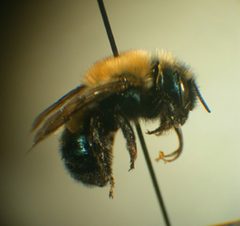
Osmia integra is a solitary in the Megachilidae, native to North America. It is distinguished by its nesting in sand dune , where it constructs shallow nests. The species was described by Cresson in 1878 and includes two recognized : O. i. integra and O. i. nigrigena. Like other Osmia species, it is a native , though specific ecological details remain understudied.
Pronunciation
How to pronounce Osmia integra: /ˈɒz.mi.ə ˈɪn.teɪ.ɡrə/
These audio files are automatically generated. While they are not always 100% accurate, they are a good starting point.
Images
Habitat
Sand dunes. The forms shallow nests in this substrate, a preference that distinguishes it from many other Osmia species that typically nest in pre-existing cavities such as hollow stems, borings, or artificial blocks.
Distribution
North America. Specific records are limited, but the has been documented across the continent.
More Details
Subspecies
Two are recognized: Osmia integra integra and Osmia integra nigrigena. The distinction between these subspecies is not detailed in available sources.
Nesting Biology
Unlike many that utilize pre-existing cavities, O. integra excavates shallow nests directly in sand dunes. This ground-nesting represents a divergent ecological strategy within the Osmia.
Sources and further reading
- BugGuide
- Wikipedia
- GBIF taxonomy match
- iNaturalist taxon
- NCBI Taxonomy
- Catalogue of Life
- Outstanding Group of UC Davis Graduate Students at ESA Meeting | Bug Squad
- 'Am I Even a Bee?' Identity Crisis Unfolds in This Charming Book | Bug Squad
- Aspiring for Better Pollination | Bug Squad
- A Gathering of Entomologists: UC Davis Faculty on Way to Portland, Ore. | Bug Squad
- In a New Study, Spring Forest Bees Get Their Due
- Welcome mason bees, Osmia spp. — Bug of the Week