
Osmia foxi
Cameron, 1901
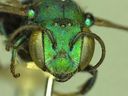
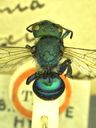
Osmia foxi is a of in the Megachilidae, subgenus Melanosmia. It was long considered enigmatic, known only from the male until its redescription in 2011, which included the first description of the female. The species is restricted to the southwestern United States and northwestern Mexico, where it occurs in montane pine-oak forest . It exhibits the metallic coloration typical of many Osmia species.
Pronunciation
How to pronounce Osmia foxi: /ˈɒz.mi.ə ˈfɒk.si/
These audio files are automatically generated. While they are not always 100% accurate, they are a good starting point.
Identification
Osmia foxi can be distinguished from other southwestern Osmia by its brilliant metallic green to blue-green coloration combined with the yellow-green . It is smaller than some sympatric Osmia species. The subgenus Melanosmia placement distinguishes it from species in subgenus Acanthosmioides such as O. palmula, which occurs in the same region. A key to Osmia species from Cochise County, Arizona, Hidalgo County, New Mexico, and adjacent counties has been published to aid identification.
Images
Habitat
Sierra Madre pine-oak forest ecoregion; montane forest in the southwestern United States and adjacent Mexico. Specific microhabitat details such as nesting substrates and elevational range are not well documented.
Distribution
United States: New Mexico and southeastern Arizona. Mexico: Sonora. The has been specifically recorded from Cochise County, Arizona, and Hidalgo County, New Mexico, with adjacent counties also included in its documented range.
Ecological Role
As a , Osmia foxi likely functions as a in its native pine-oak forest , though specific plant associations have not been documented. Like other Osmia , it presumably nests in pre-existing cavities and uses mud to construct nest partitions.
Similar Taxa
- Osmia palmulaOccurs in the same region (Cochise County, Arizona and adjacent areas) but placed in subgenus Acanthosmioides rather than Melanosmia; can be distinguished by morphological features detailed in the published key.
- Other Osmia species in subgenus MelanosmiaShare subgeneric placement but differ in coloration, size, and/or geographic distribution; identification requires use of the published key for southwestern .
More Details
Taxonomic history
Osmia foxi was described by Cameron in 1901 from a single male specimen () and remained poorly known for over a century. The was redescribed in 2011 based on newly collected material, including the first description of the female, which clarified its morphological limits and confirmed its placement in subgenus Melanosmia.
Conservation status
The is known from relatively few records (11 observations in iNaturalist as of source date). Its restricted range in the southwestern United States and northwestern Mexico may make it vulnerable to changes in the Sierra Madre pine-oak forest ecoregion, though formal conservation assessments are lacking.
Sources and further reading
- BugGuide
- Wikipedia
- GBIF taxonomy match
- iNaturalist taxon
- Catalogue of Life
- Bembicid Holdings | Entomology Research Museum
- Sharing Research About BOB | Bug Squad
- Welcome mason bees, Osmia spp. — Bug of the Week
- Mason bees make their belated debut, Osmia spp. — Bug of the Week
- Is This Non-Native Mason Bee an Invasive Species?
- European Mason Bee Lands in North America's Pacific Northwest, Likely to Spread
- Description of a new species of Osmia (Hymenoptera: Megachilidae) from southwestern North America, with a redescription of the enigmatic species Osmia foxi Cameron