
Osmia aglaia
Sandhouse, 1939
Oregon berry bee
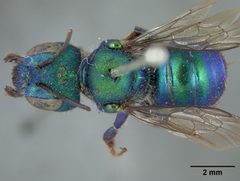
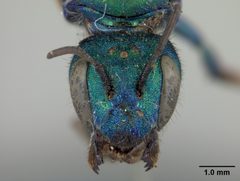
Osmia aglaia is a solitary native to the western United States. It is commonly known as the Oregon berry due to its specialized role as a of brambles, particularly raspberries and blackberries. The exhibits metallic coloration and nests in pre-existing wood tunnels. are active in late spring, coinciding with Rubus bloom periods.
Pronunciation
How to pronounce Osmia aglaia: /ˈɒz.mi.ə əˈɡlaɪ.ə/
These audio files are automatically generated. While they are not always 100% accurate, they are a good starting point.
Identification
Metallic blue, green, or rust/bronze coloration. Nests in tunnels in wood approximately 1/4–3/8 inches in diameter. Distinguished from other Osmia by its association with Rubus flowers in western Oregon and California and its specific metallic color variants.
Images
Distribution
Western United States: California, Oregon, and Washington.
Seasonality
Active as in late spring, synchronized with Rubus (bramble) flowering periods.
Diet
Pollen and nectar collected from brambles, specifically raspberries and blackberries (Rubus spp.).
Life Cycle
Nests in tunnels in wood about 1/4–3/8 inches in diameter. Females construct chambers provisioned with pollen cakes, deposit , and seal chambers with mud.
Ecological Role
Specialized of brambles in western Oregon and California, contributing to of raspberry and blackberry crops.
Human Relevance
Recognized as an agriculturally significant for berry production in its native range. No commercial management reported.
Similar Taxa
- Osmia lignariaBoth are western North American Osmia with metallic coloration, but O. lignaria is the blue orchard bee with broader plant range and commercial use in orchard pollination.
- Osmia cornifronsNon-native hornfaced introduced for orchard pollination; differs in geographic origin and management context.
- Osmia taurusNon-native Asian with potential for range overlap; differs in origin and invasion .
Sources and further reading
- BugGuide
- Wikipedia
- GBIF taxonomy match
- iNaturalist taxon
- Catalogue of Life
- Sharing Research About BOB | Bug Squad
- Welcome mason bees, Osmia spp. — Bug of the Week
- Mason bees make their belated debut, Osmia spp. — Bug of the Week
- Is This Non-Native Mason Bee an Invasive Species?
- European Mason Bee Lands in North America's Pacific Northwest, Likely to Spread
- Mason bees make an early debut, Osmia spp. — Bug of the Week