
Ashmeadiella
Cockerell, 1897
Species Guides
6- Ashmeadiella bigeloviae
- Ashmeadiella bucconis(Big-cheeked Angled-Mason)
- Ashmeadiella eurynorhyncha(Broad-nosed Angled-Mason)
- Ashmeadiella meliloti
- Ashmeadiella rubrella
- Ashmeadiella xenomastax(Square-jawed Angled-Mason)
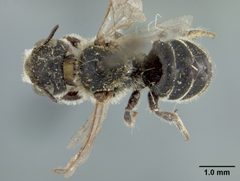
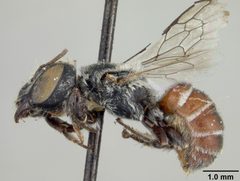
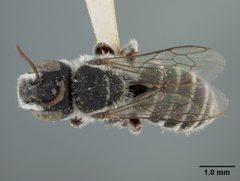
Ashmeadiella is a of solitary bees in the Megachilidae, to North America with greatest in arid and Mediterranean regions of the southwestern United States. The genus contains over 60 described . Recent molecular phylogenetic work suggests that some species may need synonymization and that established subgenera require revision due to non-monophyly. periods vary considerably among species, ranging from a few months to nearly year-round activity.
Pronunciation
How to pronounce Ashmeadiella: //ˌæʃ.miː.diˈɛl.lə//
These audio files are automatically generated. While they are not always 100% accurate, they are a good starting point.
Identification
Members of Ashmeadiella can be distinguished from other osmiine bees by combinations of morphological characters including features of the male genitalia and female scopa structure; however, -level identification often requires examination of microscopic characters. The was historically divided into five subgenera (Arogochila, Chilosima, Cubitognatha, Isomia, and Sayapis), though molecular evidence indicates these groupings are not monophyletic and taxonomic revision is needed.
Images
Habitat
Arid and Mediterranean regions, particularly in southwestern North American deserts including the Mojave Desert. occupy desert and semi-desert environments where they nest in pre-existing cavities.
Distribution
to North America; greatest diversity in southwestern United States. Over half of described have ranges extending into the Mojave Desert.
Seasonality
periods vary by from a few months to 11 months; some species exhibit nearly year-round activity.
Life Cycle
Solitary bees with cavity-nesting typical of the Megachilidae; females construct nests in pre-existing holes and provision with pollen and nectar for larval development.
Ecological Role
; most utilize floral resources from multiple plant rather than specializing on single .
Human Relevance
Subject to loss from land conversion for solar energy facilities and urban development in southwestern desert regions, with differential impacts depending on development type.
Sources and further reading
- BugGuide
- Wikipedia
- GBIF taxonomy match
- iNaturalist taxon
- NCBI Taxonomy
- Catalogue of Life
- Phylogeny, Phenology, and Foraging Breadth ofAshmeadiella(Hymenoptera: Megachilidae)
- Land Conversion for Solar Facilities and Urban Sprawl in Southwest Deserts Causes Different Amounts of Habitat Loss for Ashmeadiella Bees