
Megachile texana
Cresson, 1878
Texas leafcutter bee
Megachile texana is a solitary leafcutter bee native to the United States and southern Canada. Females construct nests using cut leaf pieces to line chambers, typically in soil burrows under rocks or clods. The was first described by Ezra Townsend Cresson in 1878. Like other Megachile species, females carry pollen on scopal hairs beneath the rather than on the hind legs.
Pronunciation
How to pronounce Megachile texana: /ˌmɛɡəˈkaɪli tɛkˈsɑːnə/
These audio files are automatically generated. While they are not always 100% accurate, they are a good starting point.
Identification
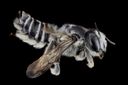
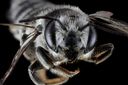
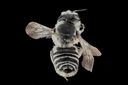
Distinguished from other Megachile by the combination of: dense whitish on and ; distinct black and yellowish-white abdominal banding; and size range of 10–13 mm. Separation from M. rubi requires examination of subtle morphological characters not covered in available sources. Nesting —cutting leaf pieces for lining—is shared with and not diagnostic alone.
Images
Appearance
Females measure 11–13 mm; males are slightly smaller at 10–12 mm. and covered with short, dense whitish hair. displays distinct black and yellowish-white banding. Wings semi-transparent with black venation. present in size.
Habitat
Pasture . Nest entrances located under rocks, under soil clods, or on small hillocks. Burrows excavated in soil, often with upper surface formed by underside of flat stones. Occasionally uses pre-existing cavities but has been observed excavating own nests.
Distribution
Native to the United States and southern Canada. GBIF records confirm presence in North America including Vermont, USA.
Diet
feed on nectar; larvae provisioned with pollen-nectar mixture. Specific floral not documented in available sources.
Life Cycle
Females construct burrows up to 25 cm long, creating one or several each lined with cut leaf portions. Each cell half-filled with pollen-nectar mixture; laid on food mass. Larva consumes provision, becomes inactive enclosed in cocoon filling the cell. Cocoon outer surface wound with brownish threads.
Behavior
Solitary nesting. Females cut leaf pieces to transport back to nest for construction. Has been observed excavating own burrows rather than solely using pre-existing cavities.
Ecological Role
. Leaf-cutting may incidentally damage ornamental foliage.
Human Relevance
Potential minor damage to garden plants from leaf-cutting activity. No documented economic importance as managed .
Similar Taxa
- Megachile rubiSimilar nesting using cut leaf pieces for lining; requires morphological examination for separation.
More Details
Taxonomic history
First described by American entomologist Ezra Townsend Cresson in 1878.
Sources and further reading
- BugGuide
- Wikipedia
- GBIF taxonomy match
- iNaturalist taxon
- NCBI Taxonomy
- Catalogue of Life
- Looking for Cheap Urban Real Estate | Bug Squad
- In Search of the World's Biggest Bee: How It Came to 'Bee' | Bug Squad
- Photographer Allan Jones Exudes Patience, Skill and Talent | Bug Squad
- The Most Incredible Image of a Leafcutter Bee | Bug Squad
- The Native Bees in the UC Davis Bee Haven | Bug Squad
- Mailbox posts are fine homes for giant resin bees, Megachile sculpturalis — Bug of the Week