
Megachile centuncularis
(Linnaeus, 1758)
Patchwork Leafcutter Bee
Megachile centuncularis, the patchwork leafcutter , is a solitary bee in the Megachilidae first described by Linnaeus in 1758. It is a widespread across the northern hemisphere, occurring in North America and Eurasia. This bee is notable for cutting circular pieces of leaves to construct and seal its nest , earning its . It is a common visitor to gardens and urban areas, where it nests in pre-existing cavities.
Pronunciation
How to pronounce Megachile centuncularis: //ˌmeɪɡəˈkaɪli sɛnˌtʌŋkjʊˈlɛərɪs//
These audio files are automatically generated. While they are not always 100% accurate, they are a good starting point.
Identification
Distinguished from other Megachile by the combination of golden abdominal fringe hairs and orange scopal hairs. The rectangular and abdominal pollen-carrying scopa are characteristic of Megachilidae. Distinguished from honey bees and bumblebees by its solitary nature, smaller size, and lack of corbiculae () on hind legs. The patchwork appearance of its leaf-lined nest is diagnostic when nests are examined.
Images
Appearance
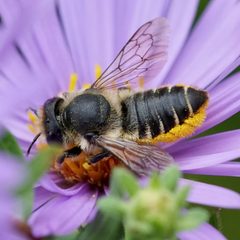
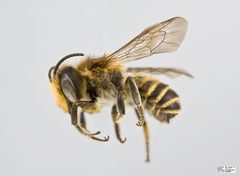
Approximately 20 mm in length. Body predominantly black. Abdominal segments fringed with golden hairs. Underside of covered with orange hairs. Carries pollen on scopal hairs located on the surface of the abdomen rather than on the hind legs.
Habitat
Occupies diverse environments including rural and urban gardens, woodlands, and open country. Nests in pre-existing cavities: hollow stems, wood holes, wall crevices, soil cavities, and artificial containers such as upturned flowerpots. Requires access to suitable leaf material for nest construction and flowering plants for forage.
Distribution
Native to the northern hemisphere with distribution spanning North America and Eurasia. In Europe, ranges from Scandinavia (Norway, Sweden, Finland) south to Spain and Italy. Present throughout Britain, more abundant in southern regions, and occurs in eastern Ireland. Generally common throughout its range.
Seasonality
active during spring and summer. Overwinters as pupae or fully developed larvae within sealed nest , emerging the following spring. Exact period varies with latitude and local climate conditions.
Diet
feed on nectar from flowers, particularly thistles (Cirsium spp.) and brambles (Rubus spp.). Larvae provisioned with pollen collected from diverse floral sources including Asteraceae, Fabaceae, and Hypericaceae.
Life Cycle
Solitary nesting . Female constructs nest in pre-existing cavity, cutting circular leaf pieces with to line and seal . Each cell is provisioned with pollen and nectar, receiving one . Nest entrance sealed with approximately six overlapping leaf discs. Development includes egg, larval, and pupal stages. occurs as pupa or mature larva within the sealed cell.
Behavior
Female cuts leaf pieces using like scissors, often selecting rose, honeysuckle, horse chestnut, ash, birch, or lilac leaves. Leaf pieces are rolled into nest . Non-aggressive; females rarely sting if undisturbed. Males emerge before females and await of females for mating.
Ecological Role
of wildflowers and crops. Contributes to pollination of plants in Asteraceae, Fabaceae, and Hypericaceae through pollen collection and nectar foraging. Provides food resources for nest and contributes to nutrient cycling through nest construction activities.
Human Relevance
Common visitor to gardens and urban green spaces, contributing to pollination of ornamental and crop plants. Frequently occupies artificial nest structures ( hotels), making it a accessible for public engagement with native . Leaf-cutting activity on ornamental plants, particularly roses, may be perceived negatively by some gardeners, though damage is generally minor.
Similar Taxa
- Megachile willughbiellaSimilar size and general appearance; distinguished by differences in abdominal hair coloration and scopal characteristics
- Osmia bicornisAlso common in hotels and similar size, but uses mud rather than leaves to seal nest and carries pollen on abdominal scopa with different coloration
More Details
Nesting in artificial structures
One of the most common occupants of garden hotels in its range, making it valuable for citizen science and conservation education. Proper bee hotel maintenance—cleaning and replacing tubes in late spring, sheltering nests over winter—is important for supporting healthy .
Sources and further reading
- BugGuide
- Wikipedia
- GBIF taxonomy match
- iNaturalist taxon
- NCBI Taxonomy
- Catalogue of Life
- Looking for Cheap Urban Real Estate | Bug Squad
- In Search of the World's Biggest Bee: How It Came to 'Bee' | Bug Squad
- Photographer Allan Jones Exudes Patience, Skill and Talent | Bug Squad
- The Most Incredible Image of a Leafcutter Bee | Bug Squad
- Meet six unsung heroes of the pollination world - Buglife Blog - Buglife
- How to be the best bee hotel manager - Buglife Blog - Buglife