
Coelioxys porterae
Cockerell, 1900
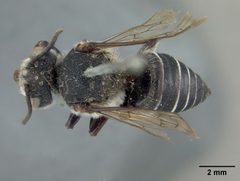
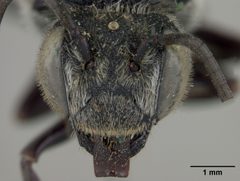
Coelioxys porterae is a of kleptoparasitic in the Megachilidae, first described by Cockerell in 1900. As a member of the Coelioxys, commonly known as sharp-tailed bees or cuckoo leafcutting bees, this species exhibits a parasitic lifestyle targeting other megachilid bees. The species is known from North America, with records from Vermont. Like other Coelioxys species, females likely deposit in the nests of bees, where their larvae consume the host's pollen provisions and kill the host egg or larva.
Pronunciation
How to pronounce Coelioxys porterae: /sɛl.iˈɒk.sɪs ˈpɔːr.tə.ri/
These audio files are automatically generated. While they are not always 100% accurate, they are a good starting point.
Identification
Coelioxys porterae can be distinguished from other megachilid bees by the characteristic sharply pointed that gives the its "sharp-tailed bees." Males typically have more conspicuously modified abdominal tips than females. Within the genus Coelioxys, -level identification requires examination of specific morphological features including abdominal punctation, hair patterns, and genitalic structures. Differentiation from the similar genus Megachile (the leafcutting bees) is straightforward: Coelioxys species have a pointed, tapered abdomen rather than the broad, abdomen of Megachile.
Images
Habitat
Distribution
North America; recorded from Vermont, United States.
Host Associations
Behavior
As a kleptoparasitic , females are expected to locate active Megachile nests and deposit between the leaf fragments lining . The resulting larvae kill the host egg or larva and develop on the pollen-nectar provisions gathered by the host female.
Ecological Role
Acts as a control agent for leafcutting populations. The parasitic lifestyle represents a natural ecological interaction within bee , with Coelioxys typically occurring at lower population densities than their .
Human Relevance
May be observed by hotel users as a natural component of solitary bee . Presence indicates a functioning with established bee . No direct economic impact; considered a natural part of native bee diversity.
Similar Taxa
- Coelioxys sodalisOverlapping North American range; requires detailed morphological examination for separation
- Coelioxys moestaSimilar size and coloration; distinction relies on abdominal and genitalic characters
- Megachile species that share similar size and general appearance; distinguished by broad and lack of abdominal point
More Details
Taxonomic note
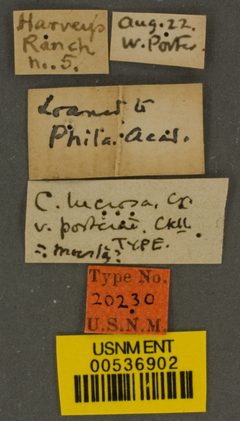
Coelioxys porterae was described by Theodore Dru Alison Cockerell in 1900. The specific epithet 'porterae' likely honors an individual, though the etymology is not documented in readily available sources.