
Anthidiellum
Cockerell, 1904
rotund resin bees
Species Guides
4- Anthidiellum ehrhorni(Ehrhorn's Rotund-Resin Bee)
- Anthidiellum notatum(Northern Rotund-Resin Bee)
- Anthidiellum perplexum(Perplexing Rotund-Resin Bee)
- Anthidiellum robertsoni
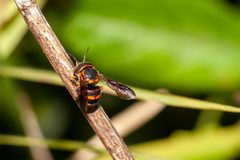
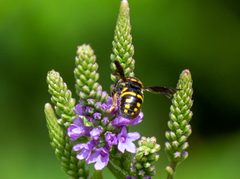
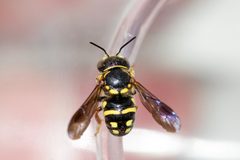
Anthidiellum is a of rotund resin bees in the Megachilidae, established by Cockerell in 1904. The genus comprises more than 60 described distributed across multiple continents. These bees are distinguished by their use of resin as the primary nesting material, constructing exposed rather than nesting in pre-existing cavities. The subgenus Ranthidiellum is rare and to Southeast Asia.
Pronunciation
How to pronounce Anthidiellum: //ˌænθɪˈdaɪələm//
These audio files are automatically generated. While they are not always 100% accurate, they are a good starting point.
Images
Distribution
Recorded from multiple regions including Southeast Asia (Thailand, Vietnam), Europe (Denmark), and North America (Vermont, United States). The subgenus Ranthidiellum is to Southeast Asia.
Diet
provision with pollen and nectar, as documented in Anthidiellum strigatum.
Life Cycle
construction occurs in three phases: building the main cell from gathered resin crumbs, provisioning with pollen and nectar while the cell remains open at the lower end, and oviposition followed by cell closure. Closure is achieved by stretching the lower cell portion into a narrow tube and filling it with small resin particles.
Behavior
Constructs unsheltered from resin, each with a downward-directed tube. Some build resinous entrance tubes to their nests. Mating has been observed in Anthidiellum notatum and Anthidiellum perplexum.
Ecological Role
.
Sources and further reading
- BugGuide
- Wikipedia
- GBIF taxonomy match
- iNaturalist taxon
- NCBI Taxonomy
- Catalogue of Life
- Observations on the Mating Behavior of Anthidiellum notatum and Anthidiellum perplexum
- Observations on the Breeding- Behaviour of the Resin Bee Anthidiellum strigatum (Hymenoptera: Megachilidae)
- Figure 3 from: Nalinrachatakan P, Traiyasut P, Khongnak A, Muangkam M, Ascher JS, Warrit N (2021) The resin bee subgenus Ranthidiellum in Thailand (Megachilidae, Anthidiini): nesting biology, cleptoparasitism by Stelis, and new species. ZooKeys 1031: 161-182. https://doi.org/10.3897/zookeys.1031.57836
- Figure 9 from: Nalinrachatakan P, Traiyasut P, Khongnak A, Muangkam M, Ascher JS, Warrit N (2021) The resin bee subgenus Ranthidiellum in Thailand (Megachilidae, Anthidiini): nesting biology, cleptoparasitism by Stelis, and new species. ZooKeys 1031: 161-182. https://doi.org/10.3897/zookeys.1031.57836
- Figure 8 from: Nalinrachatakan P, Traiyasut P, Khongnak A, Muangkam M, Ascher JS, Warrit N (2021) The resin bee subgenus Ranthidiellum in Thailand (Megachilidae, Anthidiini): nesting biology, cleptoparasitism by Stelis, and new species. ZooKeys 1031: 161-182. https://doi.org/10.3897/zookeys.1031.57836
- Figure 5 from: Nalinrachatakan P, Traiyasut P, Khongnak A, Muangkam M, Ascher JS, Warrit N (2021) The resin bee subgenus Ranthidiellum in Thailand (Megachilidae, Anthidiini): nesting biology, cleptoparasitism by Stelis, and new species. ZooKeys 1031: 161-182. https://doi.org/10.3897/zookeys.1031.57836
- Figure 4 from: Nalinrachatakan P, Traiyasut P, Khongnak A, Muangkam M, Ascher JS, Warrit N (2021) The resin bee subgenus Ranthidiellum in Thailand (Megachilidae, Anthidiini): nesting biology, cleptoparasitism by Stelis, and new species. ZooKeys 1031: 161-182. https://doi.org/10.3897/zookeys.1031.57836
- Figure 2 from: Nalinrachatakan P, Traiyasut P, Khongnak A, Muangkam M, Ascher JS, Warrit N (2021) The resin bee subgenus Ranthidiellum in Thailand (Megachilidae, Anthidiini): nesting biology, cleptoparasitism by Stelis, and new species. ZooKeys 1031: 161-182. https://doi.org/10.3897/zookeys.1031.57836
- The bee genus Anthidiellum in Vietnam: descriptions of five new species and the first male of Anthidiellumcoronum (Hymenoptera, Megachilidae).